What the ratings mean for fit
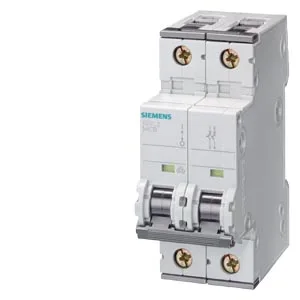
The Siemens SENTRON 5SY7206-8CC is a 2-pole miniature circuit breaker with a D tripping characteristic, rated 6 A at 230/400 V AC, 50/60 Hz. The D-curve means it tolerates high inrush currents — typically 10 to 20 times the rated current for short durations — so it's the right choice for motor, transformer, or welding-equipment branch circuits where the starting surge would nuisance-trip a B or C curve. The 30 kA breaking capacity per IEC 60947-2 tells you it can safely interrupt a fault up to 30,000 A at the supply side without welding contacts or cascading upstream; the 5 kA rating per UL 1077 and CSA C22.2 No. 235 covers North American panelboard applications. That dual rating means this one SKU works in IEC and UL installations, which simplifies BOM management for multi-national lines. The 6 A rating is at 35 °C ambient; derate to 5.56 A at 40 °C, 5.33 A at 45 °C, 5.08 A at 50 °C, and 4.82 A at 55 °C. If the panel runs hot — say near a drive cabinet or in a non-conditioned enclosure — size the load side for the derated value, not the 35 °C number. The operating temperature range is -40 to 75 °C, so it handles cold starts in unheated warehouses and hot summer days in sealed cabinets.
Panel fit and mounting
The 5SY7206-8CC occupies 2 modular width units (36 mm) on a DIN rail, with a depth of 76 mm and height of 90 mm. The quick-assembly fastening system snaps onto the rail without tools; mounting position is any orientation. Installation depth is 70 mm, so it fits standard 80 mm deep enclosures with room for wiring. The combined top and bottom terminals accept the supply from either end, which saves a bend in the wire when daisy-chaining multiple breakers. IP20 with connected conductors means it's protected against finger contact but not against moisture — standard for a DIN-rail MCB inside a closed panel. Pollution degree 3 and overvoltage category III are typical for fixed-installation distribution boards. The sealable feature allows a lead seal or lockout tag to prevent unauthorized operation, which matters for safety-lockout procedures on a machine branch circuit.