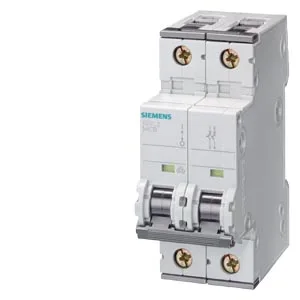
What this 50 A D-curve MCB means for your panel
The Siemens 5SY7250-8CC is a 2-pole miniature circuit breaker from the SENTRON 5SY7 series, rated 50 A with a D tripping characteristic. That D curve means it's built for loads with a high inrush — think motor starters, transformers, or welding equipment — where the magnetic trip kicks in at 10 to 20 times rated current to avoid nuisance trips on startup. It's rated 400 V AC (440 V multi- or single-phase), and the 15 kA breaking capacity per IEC 60947-2 tells you it can clear a serious fault without welding its contacts shut. For UL 1077 applications, it's listed at 5 kA.
Sizing and selectivity in the real world
At 50 A and 400 V, this MCB sits in the middle of the 5SY7 range — big enough for a moderate motor branch or a subfeed, but not a main breaker. The D curve gives you headroom for motor starting currents that can hit 8–12× FLA for a few cycles. If you're coordinating with upstream devices, the 15 kA IEC rating means it can handle fault currents up to that level; downstream, you'll want to check that your load-side wiring and equipment can ride through the let-through energy. The 10 000 mechanical switching cycles are typical for a panelboard breaker — plenty for a fixed installation, not for daily load switching.
Mounting and environment — what fits where
This breaker snaps onto a DIN rail via the quick assembly system — standard 35 mm rail, 2 width units (36 mm wide). Depth is 76 mm, installation depth 70 mm. It mounts in any position, which helps in tight enclosures. The IP20 rating (with connected conductors) means it's for dry indoor panels only — no washdown areas. But the temperature range is wide: -40 °C to 75 °C, so it'll work in unheated warehouses or hot machine cabinets. Halogen-free and silicon-free construction matters if you're in a clean-room or semiconductor fab environment where outgassing is a concern.
