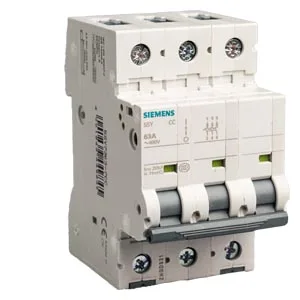
Its D tripping characteristic (10–20× In) makes it a natural fit for motor circuits, transformers, and other inductive loads that draw a heavy start-up surge without causing nuisance trips.
The D-curve (10–20× In) is the key selection parameter here. Unlike a B-curve (3–5× In) used for resistive loads or a C-curve (5–10× In) for general-purpose circuits, the D-curve allows a wider magnetic trip window — essential for motor starting where the locked-rotor current can hit 8–12× the full-load rating. If your load is a pump, compressor, or conveyor drive, this is the characteristic that keeps the breaker from opening on every start cycle. In a panel with a transformer rating that delivers a prospective short-circuit current in that range, this MCB provides the necessary SCCR headroom. The standard itself (IEC 60947-2) covers low-voltage switchgear and controlgear — it is the governing standard for industrial MCBs, distinct from the household-focused EN 60898. The 3-pole design (3P) switches all three phases simultaneously, with no neutral pole switching. That is the standard configuration for a three-phase motor or distribution circuit where the neutral is solidly bonded and does not need overcurrent protection. The IP20 rating applies only with connected conductors — the terminals are finger-safe once wired. Vibration resistance per IEC 60068-2-6 (±1 mm at 5–25 Hz, 50 m/s² at 25–150 Hz) means it holds up on a machine frame or near a motor.
Panel integration and compliance
The combined terminal design at both top and bottom accepts a range of conductor sizes; the terminals are sealable, which is useful for lockout/tagout procedures. Operating voltage is AC only, 50/60 Hz, with a maximum of 440 V in single-phase or multi-phase operation. The DC rating is limited to 72 V maximum, so do not use this on a DC bus without checking the voltage.