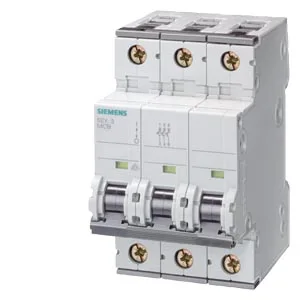
What the D-curve and dual breaking capacity mean for your panel
A standard B- or C-curve would nuisance-trip on that first half-cycle; the D-curve lets the surge pass and clears only on a sustained fault. Breaking capacity is dual-rated: 15 kA per EN 60898-1 and 30 kA per IEC 60947-2. At 30 kA it handles high-fault-current buswork without cascading upstream — that's the number your arc-flash study cares about. Rated operational voltage is 400 V AC (440 V max in multi-phase or single-phase operation), frequency 50/60 Hz.
Height 90 mm. Sealable — you can lock the handle position with a padlock for lockout/tagout. Halogen-free and silicon-free construction, which matters if this panel feeds a clean-room or semiconductor tool where outgassing contaminates optics.
Environmental and compliance envelope
Ambient operating range -40 °C to +75 °C, with humidity derating: 95% RH up to 55 °C, 55% RH up to 70 °C, 35% RH up to 75 °C. Overvoltage category III. Vibration resistance per IEC 60068-2-6: ±1 mm at 5–25 Hz, 50 m/s² at 25–150 Hz. Standards: IEC / EN 60898-1, IEC / EN 60947-2, UL 1077. The UL 1077 rating is 5 kA — that's the supplementary-protector classification, not the branch-circuit rating.