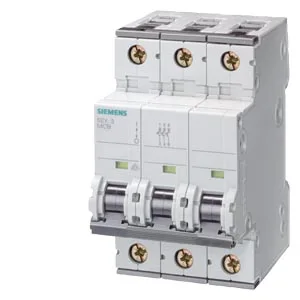
This is a Siemens SENTRON 5SY7313-8 miniature circuit breaker — 3-pole, D-curve, rated 13 A at 400 V AC. It's the part you reach for when you need high inrush immunity on motor or transformer circuits, not general lighting. Rated breaking capacity sits at 15 kA per EN 60898 and 25 kA per IEC 60947-2, with a DC rating of 15 kA per IEC 60947-2. That's enough headroom for most industrial panel sub-feeders without stepping up to a larger frame. The 76 mm depth leaves room in a shallow enclosure.
What the D-curve means on a real line
The D tripping characteristic means magnetic trip occurs at 10 to 20 times rated current (In). For a 13 A breaker, that's 130 to 260 A instantaneous — so it won't nuisance-trip on motor starting or transformer inrush, but it still clears a hard short fast. If your load is mostly resistive or general-purpose with moderate inrush, a C-curve sibling (like 5SY7140-8CC) trips at 5–10× In and gives faster fault clearance. The D-curve here is the right call for drives, pumps, and compressors.
For UL 1077 / CSA C22.2 No. 235 applications, the breaking capacity is 5 kA — check your panel SCCR if you're specifying for a North American job. The IEC ratings (15/25 kA) are what govern in European and most global installations.
Integration notes
Ambient operating range is -40 °C to 75 °C, but humidity derates above 55 °C: 95% RH up to 55 °C, then 55% RH up to 70 °C, then 35% RH up to 75 °C. If your panel sits in a hot, humid environment (near a washdown station or outdoor cabinet in the tropics), factor that into the thermal design. Vibration resistance per IEC 60068-2-6: ±1 mm at 5–25 Hz, 50 m/s² at 25–150 Hz.