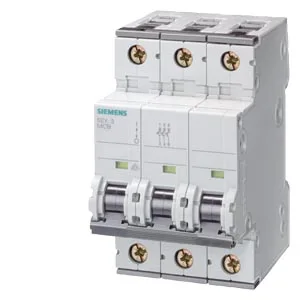
Siemens 5SY7350-7 — what it is and what the ratings mean
The Siemens 5SY7350-7 is a 3-pole miniature circuit breaker from the SENTRON family, designed for branch-circuit protection in industrial control panels. Its C-curve tripping characteristic means it handles moderate inrush currents — typical for motor starters, contactor coils, and small transformers — without nuisance trips, while still clearing overloads and short circuits within the standard thermal-magnetic response band. Breaking capacity is the headline: 15 kA per IEC/EN 60898-1 and 20 kA per IEC 60947-2. The 60947-2 figure governs industrial installations where the prospective fault current at the panel can exceed residential limits. For DC circuits it carries 15 kA at up to 72 V. Under UL 1077 it is rated 5 kA — relevant for North American supplementary protection applications where the breaker is not the sole branch-circuit overcurrent device. Rated operational voltage is 400 V AC with a maximum of 440 V in single- or multi-phase operation. Frequency is 50/60 Hz. The part carries approvals to IEC/EN 60898-1, IEC/EN 60947-2, and UL 1077, covering the three major installation frameworks — residential, industrial, and North American supplementary protection.
Panel fit and environmental limits
The 5SY7350-7 occupies 3 modular width units on a DIN rail, with a width of 54 mm, depth of 76 mm, and height of 90 mm. Installation depth is 70 mm. The quick-assembly fastening system snaps onto the rail and can be mounted in any position. The combined terminal top and bottom accept incoming and outgoing conductors without a separate busbar adapter for the line side. Ambient temperature range is -40 °C to +75 °C — wide enough for unheated enclosures in cold climates or near process heat. Humidity derating applies: max 95% RH at 55 °C, dropping to 35% at 75 °C. Degree of pollution 3 and overvoltage category III confirm suitability for fixed industrial installations where conductive pollution or transient overvoltages are expected. IP20 with connected conductors means the breaker is protected against finger contact but not against moisture ingress — it belongs inside a sealed enclosure. The housing is halogen-free and silicon-free, which matters for panels in clean-room or sensitive electronic environments where outgassing can cause contact corrosion or optical haze. The breaker is sealable — a lead seal can be applied through the housing to prevent unauthorized reset after a trip, common in safety-critical or metered circuits.
