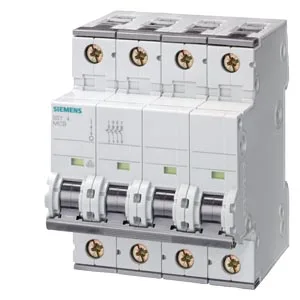
Siemens 5SY7408-8 — 4-pole D-curve MCB at 8 A
Breaking capacity is 15 kA per EN 60898 and 30 kA per IEC 60947-2, so it clears faults up to that level without cascading upstream in a 400 V AC panel.
D-curve application and breaking capacity
The D characteristic is the key selection parameter here. Where a B-curve (3–5× In) protects resistive or lighting circuits and a C-curve (5–10× In) handles general-purpose inductive loads, the D-curve (10–20× In) is sized for loads with high magnetizing inrush — small motors, solenoid valves, power supplies, and transformers. At 8 A, this 4-pole version protects a three-phase motor drawing roughly 4 kW at 400 V, or a single-phase 230 V load up to about 1.8 kW per pole, provided the inrush does not exceed 160 A for the magnetic trip. Under UL 1077 and CSA C22.2 No. 235, the interrupting rating is 5 kA — relevant if the panel carries a UL mark. The 30 kA IEC 60947-2 rating gives selectivity headroom downstream of a larger upstream device.
Sealable terminals allow the installer to lock the setting with a lead seal or tamper-evident tag, which is common in metering or rental-agreement panels. Touch protection is integrated on the terminals. Operating temperature range is -40 °C to 75 °C, with derating for humidity: 95% RH up to 55 °C, 55% RH up to 70 °C, and 35% RH up to 75 °C. Vibration resistance per IEC 60068-2-6 is ±1 mm at 5–25 Hz and 50 m/s² at 25–150 Hz — adequate for installation on machinery or in enclosures mounted on vibrating structures.