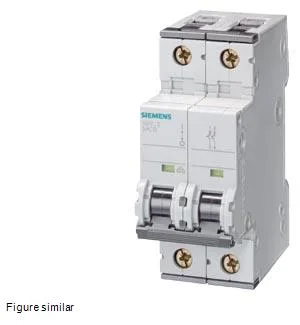
Siemens 5SY7540-6 SENTRON MCB — 40 A B-Curve, 2-Pole, 15/20 kA
The Siemens 5SY7540-6 is a SENTRON miniature circuit breaker rated 40 A with a B-curve tripping characteristic, configured as 2-pole (1P+N) in a 2-module-width (36 mm) DIN-rail housing. The B-curve (3–5× In) means it trips fast on short-circuit but tolerates moderate inrush — a fit for resistive and lighting loads rather than motor circuits.
The 40 A rating holds at 35 °C ambient; derate to 36.28 A at 45 °C, 34.96 A at 50 °C, 33.6 A at 55 °C, and 32.16 A at 60 °C (–). The 15 kA (EN 60898) and 20 kA (IEC 60947-2) breaking capacities are the maximum fault currents the MCB can safely interrupt — verify the supply-side SCCR at the distribution board. The 2-pole 1P+N configuration switches the line conductor and provides a switched neutral disconnection — required in some regional wiring rules for final circuits. Operating temperature spans -40 to 75 °C, with humidity limits of 95% up to 55 °C, tapering to 35% at 75 °C.
Construction and compliance
Halogen-free and silicon-free construction reduces corrosive off-gassing in a fire — relevant for clean-room or enclosed panel environments. Touch protection is integral. Energy limitation class 3 means the let-through energy is limited, reducing downstream equipment stress during a fault.