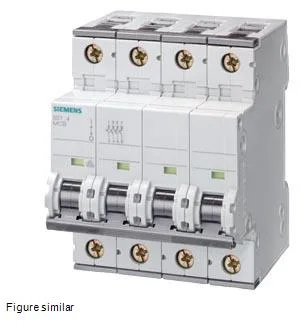
What this 5SY7601-8 is and who needs it
That D-curve means it's built for high inrush loads: motors, transformers, welding gear — anything that pulls a short surge well above its 1 A continuous rating before settling. If you're protecting a control transformer or a small motor branch circuit, this is the MCB that won't nuisance-trip on startup and can clear a hard fault without upstream coordination headaches.
What the ratings mean in the panel
Combined terminals top and bottom mean you can feed through or loop out without extra blocks. Rated IP20 with conductors connected — fine inside an enclosed panel, not for wet locations.
Three breaking-capacity ratings matter depending on the standard your local code follows: 15 kA per EN 60898 (the standard for household and similar installations), 50 kA per IEC 60947-2 (the industrial standard for low-voltage switchgear), and 5 kA per UL 1077 / CSA C22.2 No. 235 for North American supplementary protection. The 50 kA figure is the one that gives you headroom in an industrial MCC — it means this MCB can interrupt a 50 kA fault at 400 V AC without blowing apart, so you don't have to step up to a bigger frame just for the SCCR. The D-curve's magnetic trip threshold is 10-20x In (10-20 A), which keeps it coordinated downstream of a larger feeder breaker.
Where it's at home
Siemens rates this for mechanical engineering and industry — think machine tool cabinets, conveyor control panels, HVAC skids, pump stations. The D-curve suits loads with high inrush like small motors, solenoid banks, or power supplies. The 400 V AC rating covers 3-phase systems common in European and Asian industrial plants. Ambient temperature range of -40 to +75 °C means it's fine in unheated warehouses or near hot machinery, though the thermal tripping characteristic will shift at the extremes — something to keep in mind if your panel sits in a foundry or a cold storage facility.