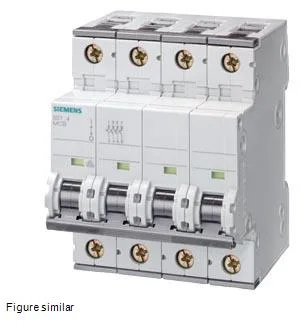
Its 15 kA breaking capacity per IEC/EN 60898-1 and 25 kA per IEC 60947-2 cover most panelboard and sub-distribution fault levels up to 400 V AC. The fourth pole switches the neutral conductor, which matters for circuits where the neutral must be isolated during maintenance or where phase-to-neutral faults are possible.
IP20 with connected conductors is the usual open-panel rating; it assumes the breaker sits inside an enclosure with a door or cover.
Breaking capacity across standards — one number is not enough
This breaker carries three distinct interrupting ratings: 15 kA at 400 V AC per EN 60898-1 (the domestic/light-commercial standard), 25 kA at 400 V AC per IEC 60947-2 (the industrial standard), and 5 kA at 277 V AC per UL 1077 and CSA C22.2 No. 235. At DC, it is rated 15 kA at 60 V per IEC 60947-2, and the maximum DC operating voltage extends to 72 V. The dual standard compliance means the same part can be specified for a machine that ships to both IEC and UL jurisdictions — one BOM line, two certification paths.
Temperature derating and environment
The breaker is rated for ambient operation from -40 °C to 75 °C, but the surrounding temperature influences the thermal trip: maximum 95 % relative humidity at 55 °C, derating to 55 % at 70 °C and 35 % at 75 °C. In a sealed panel with multiple breakers ganged together, the internal temperature rise can push the effective rating down — a panel OEM should check the thermal curve if the breaker is loaded near its limit in a crowded enclosure.
Physical integration
Depth is 76 mm, installation depth is 70 mm, height is 90 mm, width is 72 mm (4 MW). The combined terminal at top and bottom accepts both busbar and conductor connections.