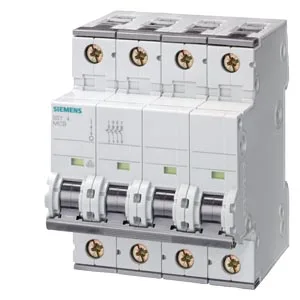
What it is and what it does
The Siemens 5SY7640-6 is a 4-pole SENTRON miniature circuit breaker with a B-curve tripping characteristic, rated 40 A at 400 V AC. It breaks fault currents up to 15 kA per EN 60898 and 20 kA per IEC 60947-2, with a DC rating of 15 kA per the same standard. The B-curve means it trips between 3 and 5 times rated current — standard for general-purpose resistive and small inductive loads where nuisance tripping from inrush isn't a concern. At 40 A on a 4-pole frame, this is a main or heavy feeder breaker in a distribution board, not a final-subcircuit device.
Where it lands in a panel
Snaps onto DIN rail via the quick-assembly system, 4 modular width units (72 mm wide), 76 mm deep. Mounting position is any — no derating for horizontal orientation. IP20 with conductors connected, so it lives inside an enclosure or distribution board, not exposed. Rated for pollution degree 3 and overvoltage category III, meaning it's built for the fixed-installation environment inside a panel where conductive dust and transient overvoltages are expected. The combined terminals top and bottom (box lug + clamp) accept a range of conductor sizes without needing separate accessories.
What the ratings mean for fit
The 40 A rating at 400 V AC is the continuous current the breaker carries without tripping. The 15 kA breaking capacity (EN 60898) governs its use in domestic/commercial distribution boards where the prospective short-circuit current at the point of installation is under that limit. The 20 kA rating per IEC 60947-2 applies when the breaker is used in industrial applications where the standard for the installation is the higher-rated industrial standard. The UL/CSA 5 kA rating (5 kA at 400 V AC) is the limiting factor for North American installations — if the available fault current exceeds that, this breaker isn't the right choice for a UL 508A panel.
Construction and environmental range
Halogen-free and silicon-free construction — no outgassing that corrodes contacts in sealed enclosures. Operating temperature range -40 °C to 75 °C, with humidity derating above 55 °C (95% RH to 55 °C, 55% to 70 °C, 35% to 75 °C). Vibration resistance per IEC 60068-2-6: ±1 mm at 5–25 Hz, 50 m/s² at 25–150 Hz. The neutral pole is switched (3P+N), so it breaks the neutral along with the phases — this matters for TN-S or TT systems where neutral isolation is required for maintenance safety.
