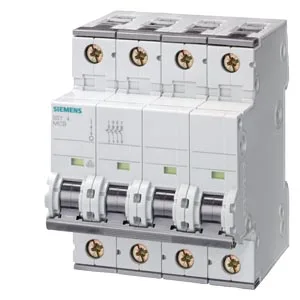
That's the figure that decides coordination in a distribution board.
The 25 kA rating at 400 V AC (IEC 60947-2) is the one that governs selectivity — if your upstream breaker is rated 36 kA or higher, you need to verify the let-through energy matches. For UL 1077 / CSA C22.2 No. 235 installations, the same breaker carries a 5 kA rating, so it's supplementary protection in North American panels unless the SCCR study supports it. The C-curve means magnetic trip between 5x and 10x In — 200 to 400 A — which covers most motor and lighting loads but won't nuisance-trip on capacitor switching or long cable runs. The 3P+N design switches the neutral, which is required for TT or IT earthing systems and some medical or UPS feeds where you need guaranteed isolation on all poles. Environmental specs matter out here in the grease: IP20 with conductors connected — fine inside a sealed panel, not for washdown zones. Vibration resistance per IEC 60068-2-6 (±1 mm at 5–25 Hz, 50 m/s² at 25–150 Hz) covers most rotating equipment routes — it'll survive next to a 200 hp pump motor.
Halogen-free and silicon-free matters if this goes into a clean room or semiconductor fab where outgassing kills yield.