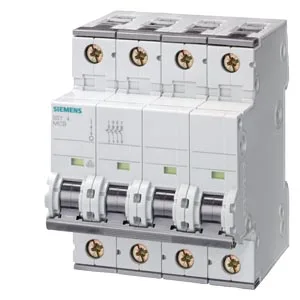
The Siemens 5SY7650-8 is a 4-pole (3P+N) SENTRON miniature circuit breaker with a D tripping characteristic, rated 50 A at 400 V AC and 72 V DC maximum. Its breaking capacity is 15 kA per IEC 60947-2 and EN 60898, with a supplementary 5 kA rating under UL 1077 and CSA C22.2 No. 235. This is a current-production part (lifecycle stage: active) from the 5SY7 design family, intended for mechanical engineering and industrial panel applications.
The 5 kA UL 1077 rating is a supplementary protector listing; it is not a full branch-circuit UL 489 breaker, so verify the local code if you are specifying for a US panelboard — this part is more commonly used in IEC-based designs. That covers everything from control-circuit tails to main feeder cables, and the combined terminal design means you land the load and the supply on the same clamp — no separate neutral bar needed for the outgoing side. The terminals are touch-protected and sealable, which matters for IP20-rated enclosures where the breaker sits behind a gland plate.
The 4-pole body occupies 4 width units (72 mm) with a depth of 76 mm and installation depth of 70 mm. Any mounting position is permitted, and the ambient temperature range is -40 to +75 °C, though humidity derating applies above 55 °C (max 95% RH at 55 °C, tapering to 35% at 75 °C). The halogen-free and silicon-free construction avoids outgassing concerns in sealed enclosures or near sensitive contacts.