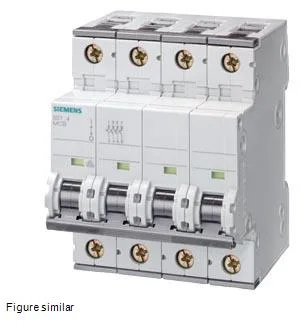
What this MCB is and what the ratings mean for your panel
The Siemens 5SY7663-8 is a SENTRON miniature circuit breaker with a D tripping characteristic, rated 63 A at 35 °C, across four poles configured as 3P+N. The D curve means it tolerates high inrush currents — typically 10 to 20 times the rated current before tripping magnetically — so it is sized for motor, transformer, or welding-equipment branch circuits where the startup surge would nuisance-trip a B or C curve. The 15 kA breaking capacity (acc. to EN 60898 and IEC 60947-2) tells you it can safely interrupt a fault current up to that level at the service entrance or subpanel without cascading upstream. At 40 °C ambient the continuous rating derates to 59.98 A, at 50 °C to 56.83 A, and at 60 °C to 53.42 A — so if your panel runs hot, you need to account for that in the load calculation, not just the 35 °C nameplate number. The 4-pole (3P+N) design with combined terminal top and bottom means it switches all three phases plus the neutral, and the neutral pole is not just a pass-through — it opens and closes with the phases, which is required for TN-S or TT systems where you need full isolation. Snap it onto a DIN rail in any mounting position; the quick-assembly system and 4 MW width (72 mm) mean it occupies four modular spaces in a standard distribution board. Sealable and touch-protected per the spec, so it meets the requirements for lockout/tagout in industrial panels without an extra enclosure.
D-curve selectivity and coordination notes
With a D characteristic and 15 kA rated short-circuit capacity, this breaker coordinates well downstream of a larger SENTRON molded-case or air circuit breaker in a selective scheme.
Environmental and compliance specs for documentation
The 5SY7663-8 is halogen-free and silicon-free, which matters for panels in clean rooms or areas where outgassing can contaminate optics or contacts. Operating temperature range is -40 °C to +75 °C, with humidity influence capped at 95% up to 55 °C, then derated to 35% at 75 °C. Pollution degree 3 and overvoltage category III mean it is rated for industrial environments with conductive pollution and transient overvoltages up to 4 kV — typical for main distribution panels in factories. IP20 with connected conductors; once wired, the terminals are finger-safe. The product designation per IEC 81346-2 and DIN EN 61346-2 is F (protective device).
