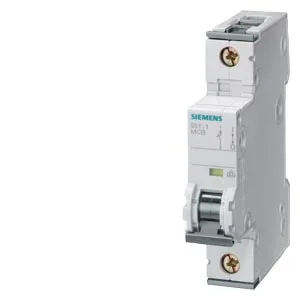
Siemens 5SY8108-7 — SENTRON 1-pole MCB, C-curve, 40 kA breaking capacity
Its C-curve tripping characteristic suits moderate inrush loads — motor starters, contactor coils, small transformers — where the magnetic trip threshold sits at 5–10× rated current, avoiding nuisance trips on startup while clearing hard faults fast. The 40 kA rated breaking capacity at 400 V AC per IEC 60947-2 gives solid SCCR headroom for most 400 V industrial feeders; the 15 kA DC rating at 60 V covers battery-backed control circuits and DC bus protection. At 18 mm wide, it occupies one modular unit on DIN rail, with any mounting position and quick-assembly fastening for dense panel layouts.
For UL 1077 supplemental protection, the same part is listed at 5 kA, which is typical for supplementary breakers on that standard. The DC side at 60 V delivers 15 kA, with a maximum DC operating voltage of 72 V — enough for 48 V battery banks or 60 V DC bus rails found in telecom and UPS circuits. The C-curve means magnetic trip between 5× and 10× In; on a 10 A rated breaker, that's a 50–100 A instantaneous threshold, so it passes motor inrush but clears a bolted fault within a half-cycle.
Environmental and installation constraints
The derating curve is explicit: 95 % humidity up to 55 °C, 55 % up to 70 °C, 35 % up to 75 °C — so in a sealed, non-ventilated panel near a heat source, you stay within the lower humidity bands. Vibration resistance per IEC 60068-2-6 — ±1 mm at 5–25 Hz, 50 m/s² at 25–150 Hz — confirms it holds calibration under pump and compressor vibration.