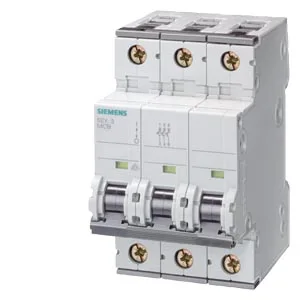
The D-curve means the magnetic trip threshold sits at 10 to 20 times the rated current, so it passes the startup surge of a 4 kW motor or a 500 VA control transformer without nuisance tripping, yet still clears a hard fault fast. That 50 kA breaking capacity at 440 V AC (per IEC 60947-2) is the headline number: it tells you this breaker can interrupt a fault up to 50,000 amps without welding its contacts or cascading upstream — essential for a panel fed from a high-capacity transformer or a distribution bus with low source impedance.
Sizing and derating — the real-world current you can carry
The 6 A rating holds at 45 °C ambient. At 50 °C it derates to 5.85 A, and at 55 °C to 5.69 A. The breaker is rated for 50/60 Hz supply and carries a DC breaking capacity of 15 kA at 72 V (per IEC 60947-2), which covers most 24 VDC and 48 VDC control bus applications, though the DC voltage max is 72 V so don't push it onto a 110 VDC battery bank. For UL 1077 / CSA C22.2 No. 235 recognition, the interrupting rating is 5 kA — that's the figure your North American panel shop will look at for supplementary protection.
The fastening method is a quick assembly system — push on, clip in, no tools. The terminals are combined (phase and neutral busbar compatible top and bottom), and touch protection is built in. Vibration resistance per IEC 60068-2-6: ±1 mm at 5 to 25 Hz, 50 m/s² at 25 to 150 Hz — fine for mounting on a machine frame or a conveyor drive panel.
Sourcing — where to get it and what to expect
No minimums beyond the quantity you actually need.