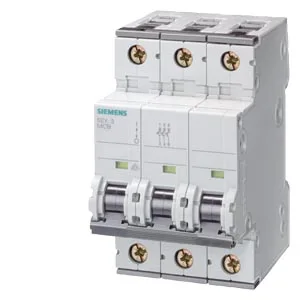
The magnetic-only trip (no thermal bimetal) means it reacts solely to short-circuit currents, not overloads, so it's paired with a separate overload relay or motor-protective device. IP20 with connected conductors — standard for panelboard use, not for wet environments.
The 25 kA rating at 400 V AC (IEC 60947-2) is the headline number. For UL 1077 / CSA C22.2 No. 235 applications, the rating drops to 5 kA — a common derating when moving from IEC to North American supplementary protector standards. If your panel SCCR calculation depends on this device, the 5 kA figure is the binding limit for UL-listed assemblies. That's higher than a B or C curve, so it won't nuisance-trip on motor start or capacitor bank inrush. But it also means the let-through energy (I²t) is higher during a fault — verify downstream cable and device withstand if coordinating with a smaller branch.
Panel integration
Sealable design allows lockout/tagout provisions.
Environmental and electrical margins
Humidity derating applies above 55 °C: max 95% RH up to 55 °C, then 55% RH to 70 °C, then 35% RH to 75 °C. Vibration resistance per IEC 60068-2-6: ±1 mm at 5–25 Hz, 50 m/s² at 25–150 Hz — survives normal machine vibration but not continuous high-frequency shaker tables. For a 3-pole breaker that's 9 W total — negligible for thermal budgeting in most panels, but worth summing if you have dozens of breakers in a sealed enclosure.