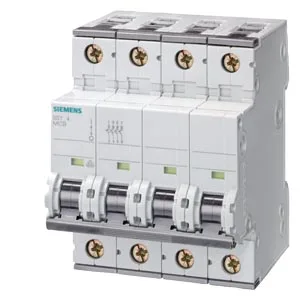
The Siemens 5SY8440-8BB08 is a 4-pole miniature circuit breaker from the SENTRON family, designed with a D tripping characteristic and a magnetic-only trip mechanism. It's rated for 400 V AC at 50/60 Hz with a breaking capacity of 25 kA per IEC 60947-2, and 5 kA per UL 1077 and CSA C22.2 No. 235. The D curve means it's built for loads with high inrush currents — think motor circuits, transformers, or welding equipment — where the short magnetic trip delay prevents nuisance tripping on startup.
Mounting and integration
Snaps onto DIN rail via the quick assembly system and occupies 4 modular width units (72 mm total width). Mounting position is any orientation, which helps when you're packing a tight panel. Installation depth is 70 mm; the overall depth including terminals is 76 mm. Combined terminals at top and bottom accept supply from either direction — no need to flip the breaker for top-feed vs bottom-feed.
Environmental and compliance
Rated for pollution degree 3 and overvoltage category III, which covers industrial environments where transient overvoltages are common. Ambient temperature range spans -40 °C to 75 °C, with derating for humidity: max 95% RH up to 55 °C, then dropping to 35% at 75 °C. The housing is halogen-free and silicon-free — a plus for clean-room or food-grade installations where outgassing matters. Vibration resistance per IEC 60068-2-6: ±1 mm at 5–25 Hz, 50 m/s² at 25–150 Hz. Mechanical service life is 10,000 operating cycles typical.
Key ratings and what they mean
The 25 kA breaking capacity at 400 V AC per IEC 60947-2 means this breaker can safely interrupt fault currents up to that level without welding contacts or causing arc flash damage downstream. The UL 1077 supplementary protector rating of 5 kA covers North American installations where it's used as a branch-circuit protector. Power loss per pole is 3 W at rated current in hot operating state — factor that into panel thermal calculations if you're packing multiple breakers side by side. The magnetic-only trip (no thermal bimetal) makes it suitable for short-circuit protection only; overload protection must be provided upstream or by a separate device.