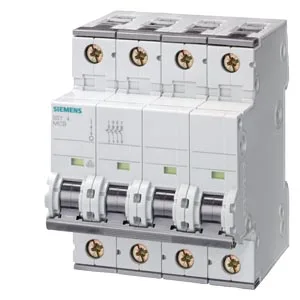
What this MCB covers
The Siemens 5SY8413-7 is a 4-pole SENTRON miniature circuit breaker with a C tripping characteristic, rated 13 A at 400 V AC. It breaks fault currents up to 30 kA per IEC 60947-2, which means it clears high-energy short circuits in industrial panels without upstream coordination headaches. The C-curve (5–10x In) suits motor and transformer branch circuits where inrush isn't extreme but still needs magnetic-trip headroom over resistive loads. Mounts on a DIN rail via the quick-assembly system, occupies 4 width units (72 mm), and accepts any mounting position. The IP20 rating with connected conductors is standard for enclosed panel gear — no special sealing needed inside a cabinet.
Breaking capacity and coordination
Three breaking-capacity ratings matter for panel coordination: 30 kA at 400 V AC per IEC 60947-2 (the industrial standard for MCCBs and MCBs), 15 kA at 72 V DC, and 5 kA per UL 1077 / CSA C22.2 No. 235. The IEC figure is the one that governs selectivity in European-style distribution boards; the UL/CSA figure is lower, so if the panel must carry a 10 kA SCCR under UL 508A, this breaker alone won't cover it — you'd need a current-limiting upstream device or a higher-rated supplementary protector. Overvoltage category III means it's rated for fixed-installation downstream of the main distribution board — not for equipment-level (Cat II) or meter-side (Cat IV) placement. That aligns with its intended role in mechanical engineering and industry branch circuits.
Integration notes
Installation depth is 70 mm, overall depth 76 mm — fits standard 80 mm deep enclosures with room for wiring. Combined terminals top and bottom accept supply from any direction. Halogen-free and silicon-free construction matters if the panel is in a clean-room or food-production environment where outgassing contaminants can't be tolerated. Temperature derating applies: max 95% relative humidity up to 55 °C, then 55% up to 70 °C, then 35% up to the 75 °C maximum. If the panel ambient runs above 55 °C, the breaker's thermal trip point shifts — factor that into the branch-circuit ampacity calculation.