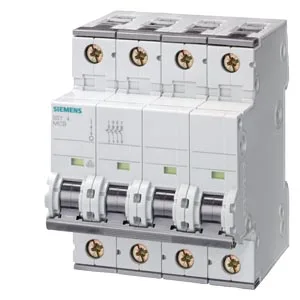
The 5SY8615-7: The C-curve means the magnetic trip threshold sits between 5× and 10× In (roughly 8 to 16 A for this 1.6 A unit). That's the right fit for a small motor branch or a group of contactors — enough headroom to avoid nuisance trips on magnetizing inrush, but still fast enough to clear a hard short.
Breaking capacity — the real-world number
For DC circuits it's rated 15 kA per the same standard, and under UL 1077 / CSA C22.2 No. 235 it's listed at 5 kA. The 70 kA figure governs in IEC-spec panels; the UL rating matters if the panel is built to North American standards.
Mount it in any position — vertical, horizontal, flat — the breaker doesn't care. It's IP20 with conductors connected, so it's meant for enclosed distribution boards, not open washdown areas. Both top and bottom terminals are combined (busbar and conductor in the same clamp), which simplifies panel wiring. The neutral pole is switched but not fused — the 3P+N configuration lets you break the neutral on fault or isolation without carrying overcurrent protection on that pole.
Temperature derating and environmental range
The 1.6 A rating holds at 45 °C ambient. At 50 °C it derates to 1.57 A; at 55 °C it's 1.53 A. That's a gentle slope — about 2% drop per 5 °C rise — so in a warm panel you still have most of the rated capacity. Vibration resistance per IEC 60068-2-6: ±1 mm at 5 to 25 Hz, 50 m/s² at 25 to 150 Hz. That covers the shake you get from a nearby motor or pump on a steel frame — not a problem for a DIN-rail mount in a typical industrial panel.