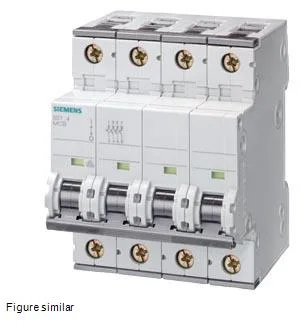
Its interrupting rating of 30 kA at 400 VAC per IEC 60947-2 gives real fault-current headroom on a 400 V three-phase system; the same breaker also carries a UL 1077 listing at 5 kA for North American supplementary protection applications.
The 30 kA breaking capacity at 400 VAC (IEC 60947-2) is the headline number — it tells you this breaker can safely interrupt a fault current up to 30,000 A without welding contacts or rupturing the case. That's well above typical 10 kA or 16 kA panelboard ratings, so it gives selectivity headroom for main or sub-feed positions. At DC, the rated breaking capacity drops to 15 kA at 60 V (max 72 V), which still covers many 48 V or 60 V control bus applications. Ambient temperature affects the thermal trip: the breaker is calibrated for 30 °C, and the evidence shows derating guidance up to 75 °C (max 95% RH at 55 °C, dropping to 35% at 75 °C). In a hot enclosure next to drives or transformers, factor that in. Physically, it's 72 mm wide (4 modular width units), 90 mm tall, and 76 mm deep with a 70 mm installation depth behind the panel. Vibration resistance per IEC 60068-2-6 is ±1 mm at 5–25 Hz and 50 m/s² at 25–150 Hz, so it holds up on a machine skid or near rotating equipment.
Compliance and approvals at a glance
Designed and tested to IEC / EN 60947-2 (the main standard for industrial MCBs) and UL 1077 (supplementary protection for North America). Overvoltage category III (fixed installation, distribution level). The manufacturer's standard compliance documentation package covers CE, UKCA, EAC, and CB scheme certifications — the typical set for a global-install part.