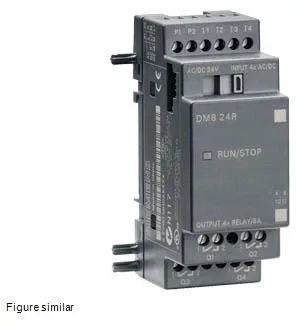
What this module is
Ratings that drive the fit decision
Relay contacts are rated 5 A resistive per point, but the inductive ceiling is 3 A per relay, and the resistive figure halves to 3 A above 55 °C with a 5 A / 10 A-burst allow-and-decay shape — meaning the continuous current a wireman can assume is 3 A per point in a hot cabinet, not 5 A. Outputs carry no built-in short-circuit protection, so the branch protection has to live upstream in the panel — that decides the fusing layout on every drawing. Supply window is 20.4–28.8 V DC, but it tightens to 22–27.5 V once the cabinet runs above 55 °C; if a retrofit lands in a hot enclosure, the DC rail tolerance shrinks and a buck-rated PSU may stop being acceptable. Operating temperature spans -40 °C to 70 °C, with the UL/cUL use file accepting up to 55 °C — the wider -40 to 70 range is the industrial envelope, but the UL recognition is what governs a North American panel. Installation altitude is rated to 5 000 m with a stepped derate — Tmax − 10 K above 2 000 m and Tmax − 20 K above 3 500 m — so a high-elevation site loses thermal headroom, not the part's ability to be installed.
Where it lands in a panel
With four relay outputs and four digital inputs, the module is sized for distributed control of small loads — pilot relays, solenoid valves, contactor coils, small heater bands, signal lamps — typically as a remote or stand-alone I/O island beside a master LOGO! or third-party controller.
Approvals — what is and is not on the file
FM approval, CSA approval and marine approval are not on the file — hazardous-area deployments, Canadian-only panels where CSA marking is called up, and shipboard installations are out of scope on this order code.
Sourcing posture
Close-out for the BOM line
For a panel that needs 4 relay outputs at 5 A resistive with a -40 °C cold-start envelope and UL listing, this code is the fit; for a Canadian-marked or marine application it is not — a request for quotation on the order code confirms current availability, the unit-of-origin trace and the UL file carry-over.