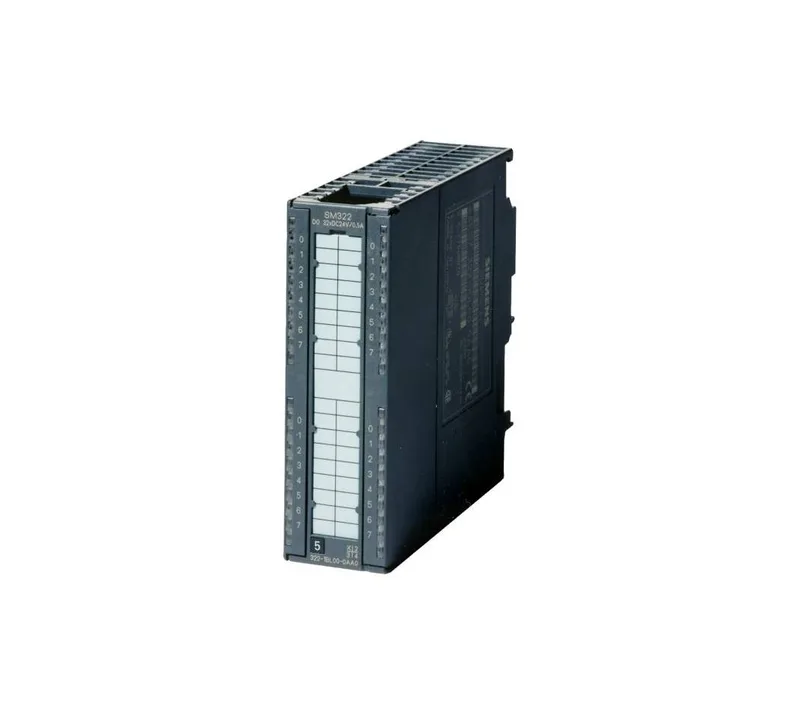
Active production — extended temperature S7-300 DO
The 6AG1322-1CF00-7AA0: The wide supply range (48-125 VDC) covers nominal 48 V, 60 V, 72 V, 110 V, and 125 V DC control buses common in rail, marine, and industrial sites — no separate module variant needed for each rail voltage.
Railway temperature grade and environmental certs
The UL listing (File E239877) and CE, EAC, KC, and RCM marks cover North American, European, Eurasian, Korean, and Australian regulatory acceptance. The 1500 V AC channel-to-channel isolation test confirms galvanic separation between outputs — critical when adjacent channels feed different control circuits or share a common fault path.
Current derating and output characteristics
The 4 A per-channel rating holds at 40 °C and 50 °C, then drops to 3 A at 60 °C and 1 A at 70 °C. The response threshold is 4.4 A typical — the module trips the group-error LED (SF red) when an output exceeds this level, but there is no per-channel fuse or diagnostic alarm. Spare fuses (6.3 A / 250 V, quick-response, 5x20 mm) are carried on the module for field replacement. Switching times are 2 ms max (0→1) and 15 ms max (1→0), with a maximum lamp-load frequency of 10 Hz. The minimum signal-1 voltage is L+ (-1.2 V), so the output stage saturates close to the supply rail — important for long cable runs where voltage drop is a concern.
Physical fit and cable length limits
The module occupies one S7-300 slot (40 mm wide, 125 mm high, 120 mm deep, ~250 g) and requires a 20-pin front connector (ordered separately). Unshielded cable runs up to 600 m; shielded runs up to 1000 m — the 600 m unshielded limit is the practical constraint for most plant-floor wiring without conduit. Typical power loss is 7.2 W — account for this in the enclosure thermal budget, especially when multiple modules populate the rack in a sealed cabinet.