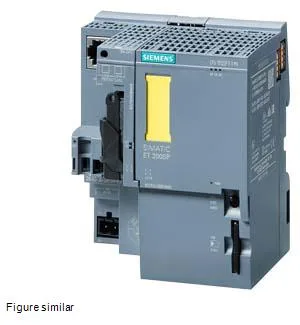
CPU Role and Failsafe Architecture
The 6AG1512-1SK01-7AB0: Forcing is allowed only in non-failsafe logic, which is standard for safety-rated CPUs: you can force a standard output during commissioning, but the safety channel remains protected.
Programming and Diagnostic Coverage
This CPU supports all five IEC languages: LAD, FBD, STL, SCL, and GRAPH. LAD and FBD include failsafe blocks, so you can program safety functions in ladder or function block. The GRAPH language is useful for sequential controls like batch processes. Diagnostic LEDs for ERROR and MAINT give immediate status without connecting a panel. Integrated PID-Temp and controllers include auto-tuning for temperature loops and valve positioning. That reduces the need for a separate loop controller or external PID module.
Communication and Protocol Support
Onboard Ethernet supports IRT, TCP/IP, UDP, MODBUS TCP, DHCP, DNS, DCP, SNMP, LLDP, and HTTP/HTTPS for standard and user web pages. The DNS and DCP protocols make network discovery and naming straightforward in PROFINET environments. RS-485 is available via a CM DP module for Modbus RTU or PROFIBUS DP. MRP is not supported, and MRPD is also not supported. That means this CPU is not intended for redundant ring topologies with media redundancy; use standard PROFINET line or star topologies.
Protection and Thermal Coordination
The CPU has an I2t rating of 0.14 A²·s. This is a thermal energy limit for internal protection — useful for cabinet coordination when sizing upstream fuses or breakers. It is not a branch circuit rating, but it confirms the CPU will ride through normal motor starting currents without immediate trip.