MRP redundancy and ring topology — what it means for your line
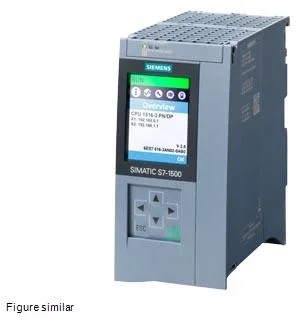
The 6AG1516-3FN01-2AB0: This CPU supports MRP (Media Redundancy Protocol) as both redundancy manager and client, with a maximum of 50 devices in the ring. That means you can build a PROFINET ring with deterministic failover — if a cable or switch fails, the ring reconfigures in under 200 ms, keeping the line running. IRT (Isochronous Real-Time) is supported for deterministic cycle-synchronous I/O, critical for motion control or high-speed inspection stations where jitter tolerance is in the microsecond range.
Extended temperature range and environmental fit
Rated for -40 °C to 70 °C ambient — this is the S7-1500 variant for unheated enclosures, cold storage, or outdoor cabinet installations. Note the manufacturer's advisory: below 0 °C, display legibility and dynamic content representation may be slower, so plan for remote monitoring if the panel sits in a freezer. Dimensions are 70 mm wide, 147 mm high, 129 mm deep — standard S7-1500 form factor, snaps onto the same DIN rail as the rest of the 1500 family.
Safety programming and communication
FBD (Function Block Diagram) programming includes failsafe blocks — this CPU runs safety applications up to SIL 3 via PROFIsafe without a separate safety relay. The same LAD (Ladder) programming also includes failsafe support, so you can mix standard and safety logic in one project. DCP (Discovery and Configuration Protocol) is supported, which means the CPU can be addressed and assigned an IP via the Siemens toolchain without a DIP switch or prior network configuration — useful for panel builders staging multiple units.
Process image and communication expansion
The process image handles 32 kbyte of inputs and 32 kbyte of outputs — all I/O is in the image, so no partial updates or manual refresh calls in the user program. That's enough for several hundred digital points plus analog channels without overrunning the cycle time. Up to 8 communication modules or CPs can be inserted for PROFIBUS, additional PROFINET, or Ethernet interfaces. This gives you flexibility to connect legacy fieldbus segments alongside the native PROFINET network.