What this module does on the plant floor
The Siemens 6AG1741-1AA00-2AA0 is a compact industrial Ethernet security module that sits between your PLC network and the outside world — think of it as a firewall and VPN concentrator rolled into a DIN-rail package. It runs a Stateful Inspection firewall, meaning it tracks the state of active connections and only permits traffic that matches known sessions, rather than just filtering by port number. That matters when you have a production line with multiple PLCs talking to an MES system over a flat network — you can segment the control traffic without redesigning the whole topology. It supports HTTPS for web-based management, NTP for time sync across the automation network, and a full set of NAT features: 1:1 NAT, NAT traversal, and IP masquerading. If your plant has a private 192.168.x.x range and you need a remote engineer to reach a specific PLC through a cellular uplink, this module handles the address translation without exposing the internal devices directly.
DIN-rail fit and environmental limits
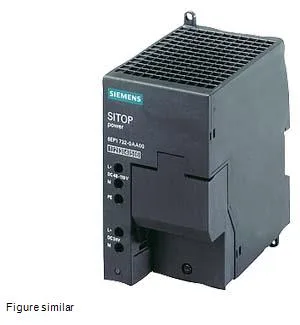
No wall-mount option, so plan for rail space. Protection class is IP20, which means it's for indoor, dry enclosures only — no washdown areas or dusty environments without a sealed cabinet. That covers most factory-floor conditions short of a foundry or freezer tunnel. Typical power consumption is 4 W — low enough that it doesn't need forced ventilation in a well-ventilated panel, but check your cabinet's thermal budget if it's densely packed.
Network interfaces and connectivity
The internal network side uses a single RJ45 port supporting 10/100 Mbit/s with auto-crossover. The external network connects via an SMA antenna socket (50 ohms) — this is for a cellular modem or external antenna, not a direct Ethernet drop. So the typical deployment is: the plant LAN plugs into the RJ45, and the WAN side goes through a cellular router or 3G/4G modem attached to the SMA connector. GSM transmission is supported at 9600 bit/s for fallback or low-bandwidth telemetry. It also acts as a DHCP client and supports DynDNS — useful if your WAN connection uses a dynamic public IP. DNS caching speeds up repeated lookups on the local network.
Security features and remote access
Beyond the Stateful Inspection firewall, the module supports VPN with Main Mode and Quick Mode — these are IPsec negotiation phases. Main Mode authenticates both sides before exchanging keys; Quick Mode sets up the actual encrypted tunnel. If you're setting up a site-to-site VPN between two plants or giving a remote engineer access to a specific machine, these modes let you match the security policy of your existing infrastructure. Password protection secures the web interface. Packet filtering with logging gives you an audit trail of blocked traffic. Note that CLI and Telnet are not supported — all configuration is through the HTTPS web interface. HTTP is also disabled, so no plain-text management traffic on the wire.