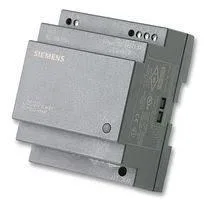
The Siemens 6EP1332-1SH42 is a SITOP PSU100M power supply delivering a rated output of 2.5 A and a maximum of 8 A at 24 VDC, with a wide AC input range of 100–240 VAC at 50/60 Hz. It snaps onto a standard DIN rail EN 60715 35×7.5/15, making it a straightforward fit into any control cabinet.
The 8 A maximum output (with a 2.5 A rated continuous) tells you this supply is sized for a small control circuit — think a handful of PLC cards, relays, and a small HMI, not a bank of motor starters. The internal fuse protection means you do not need an external fuse on the output, saving a slot on the DIN rail. The I²t value of 3 A²·s is the energy let-through during a fault; your upstream breaker (recommended: 16 A B-curve or 10 A C-curve) needs to coordinate with that to avoid nuisance trips. Galvanic isolation to SELV per EN 60950-1 and EN 50178 means the output is safety extra-low voltage, separated from the mains — critical for any control circuit that an operator might touch. The NEC Class 2 listing confirms the output is limited-power, which simplifies wiring in North American panels (no conduit required for the DC side in many cases).
SITOP PSU100M supplies are the standard choice for powering 24 VDC control loads in industrial panels — PLCs, I/O racks, sensors, relays, and small solenoid valves. The 6EP1332-1SH42 fits in a machine control cabinet, a conveyor line junction box, or a small automation cell where the total DC load stays under 8 A peak.
Compliance and Approvals — What the Certifications Mean
This supply carries CE marking for the European market, EAC for the Eurasian Customs Union, and DNV GL marine type approval — so it is accepted on ships and offshore installations. The UL/cULus listing (UL 508, CSA C22.2 No. 107.1) and cURus recognition (UL 60950, CSA C22.2 No. 60950) cover both industrial control equipment and IT equipment standards, giving it broad acceptance in North American panels. No ATEX or IECEx approval, so it is not certified for explosive atmospheres.
Snaps onto DIN rail EN 60715 35×7.5/15. The input terminals are single screw terminals for 0.5–2.5 mm² wire; the output uses two screw terminals per polarity for the same wire range — allows daisy-chaining to a downstream load without a separate terminal block. The 20 mm top and bottom clearance (0 mm left/right) means you can butt multiple supplies side-by-side, but leave 20 mm above and below for airflow.