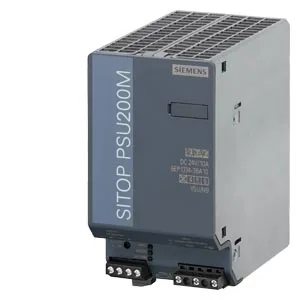
The 6EP1334-3BA10: The 10 A rating is the continuous output at 25 °C ambient; above 60 °C you derate 2%/K at 120/230 V input, or 3.5%/K at 400 V. That means at 70 °C with 400 V in, you lose 35% — down to about 6.5 A usable. Plan your load margin accordingly. Input range covers 85–264 V AC single-phase and 176–550 V AC two-phase, so it handles both standard North American 120/240 V and European 230/400 V without a tap change. Line frequency is 47–63 Hz. Output is SELV per EN 60950-1 and EN 50178, galvanically isolated. IP20 means it's for dry indoor panels only — no washdown or dust ingress protection. Mount it away from coolant mist or condensation paths.
Approvals include UL 508, CSA C22.2 No. 107.1 (cULus listed, File E197259), plus cCSAus to 60950-1, CE, EAC, and DNV GL marine type approval. That covers most industrial and marine panel specs without extra paperwork. MTBF at 40 °C is over 1 million hours (1,055,408 h), which aligns with the SITOP line's reputation for long service life in continuous-duty applications.
The unit has a selector switch on the device to set the output voltage — no DIP switches to lose. Internal fuse is T 6.3 A, not user-accessible, so branch circuit protection must be provided externally: Siemens recommends a 6–10 A miniature circuit breaker (characteristic C or B) for single-phase, or a 3RV2 motor-protective breaker for two-phase operation. Dimensions are 50 mm wide × 125 mm deep × 120 mm high (approx) — that's a standard 50 mm top hat rail footprint, same as many SITOP compact units. Leaves room for adjacent breakers or terminals in a typical 600 mm wide panel. No ATEX or IECEx certification, so not rated for hazardous locations. If the panel sits in a Zone 2 area, you'll need a different supply.