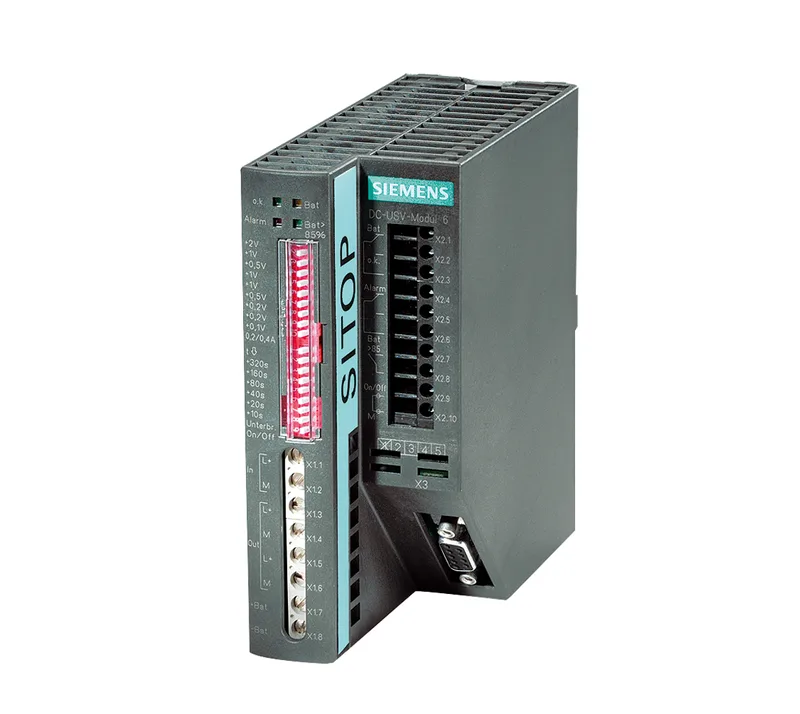
The Siemens 6EP1931-2EC21 is a DC UPS module that sits between a 24 V DC power supply and the load, providing buffered backup when the mains drops. Rated for 15 A continuous output with 360 W active power, it supports loads up to that current draw. Input voltage range is 22 to 29 V DC, and output follows input minus roughly 0.5 V — so a 24 V supply gives about 23.5 V on the bus during normal operation. Mounting is straightforward: snaps onto DIN rail EN 60715 35x7.5/15, no tools needed. Enclosure is 50 mm wide, 125 mm deep, 125 mm high — fits a standard 50 mm slot in a panel. IP20 protection means it's for dry indoor cabinets only, not washdown areas.
The 15 A rated current is the continuous output the module can deliver while buffering. Peak current hits 15.7 A — that's the short-term surge when the battery kicks in, not a steady-state rating. If your load pulls more than 15 A continuously, this module won't hold; step up to the 20 A or 40 A SITOP siblings. Charging current is listed as 0.35 A and 0.7 A — that's the rate at which the internal charger refills the battery module after a discharge. Lower charging current means longer recharge time between events; 0.7 A is the faster option if you have the battery capacity. Storage and transport range is -40 to +85 °C.
cULus-Listed under UL 508 and CSA C22.2 No. 107.1, File E197259. CE marked, EAC approved. Shipbuilding approvals from ABS and DNV GL — so it's accepted in marine and offshore panels. Emission standard is EN 55022 Class B, immunity per EN 61000-6-2. No C-Tick — not certified for Australia/New Zealand.
Wiring and connections
Input side: two screw terminals accepting 1 to 4 mm² (17 to 11 AWG) for 24 V DC. Output side: four screw terminals, same wire range. That gives you two separate output feeds if needed, or one feed plus a sense line. Permissible contact current for the signaling relays is DC 60 V / 1 A or AC 30 V / 1 A — enough for PLC digital inputs or indicator lamps. Startup delay is typical 1 second — the module waits before engaging the battery after a power fail, to avoid cycling on short dips.