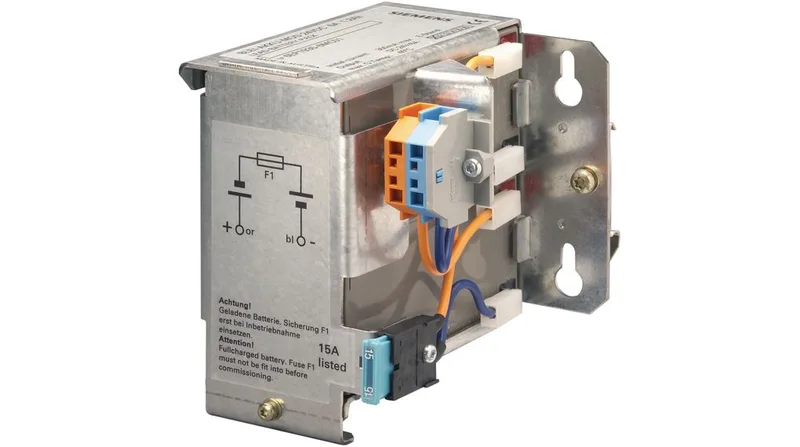
The 6EP1935-6MF01: What matters for uptime planning: the float service life is entirely temperature-driven. At 20 °C the module delivers a typical 4-year life; at 30 °C that drops to 2 years, and at 40 °C to 1 year. If your enclosure runs warm — and most control cabinets do — you need to derate the replacement interval accordingly. The 50 °C figure (0.5 a) is essentially a warning: this battery should not live in a hot panel without active ventilation.
Charging and Integration
Charging current is limited to a maximum of 3 A, which governs the charge time and the upstream DC-UPS sizing. The module ships with an accessories pack containing a solid-state circuitry fuse rated at 20 A and 30 A — one less thing to source separately for the panel build. The charging voltage must be temperature-compensated: at 20 °C the recommended float voltage is 27.3 V, rising to 29 V at -10 °C and dropping to 26.3 V at 50 °C. This is not a 'set and forget' parameter — the DC-UPS unit or charge controller must have a temperature sensor input or the battery will be under- or over-charged across the seasonal range. Mounting is via keyhole slots for M4 screws onto a flat surface — no DIN rail, no S7 rail. The module occupies 253 mm width, 168 mm height, 121 mm depth, so plan for dedicated panel real estate, not a DIN channel. Terminal connections are screw-type accepting 0.08 to 4 mm² for the battery leads.
The module carries cURus recognition to UL 1778 and CSA C22.2 No. 107.1 (File E219627), CE marking, and EAC approval. For marine and offshore applications it holds ABS and DNV GL shipbuilding approval — a non-negotiable for any vessel or offshore platform UPS circuit. ATEX rating is explicitly No — this is not certified for explosive atmospheres. IP00 protection class means it is a panel-internal component only — no exposure to dust or moisture without an enclosure.