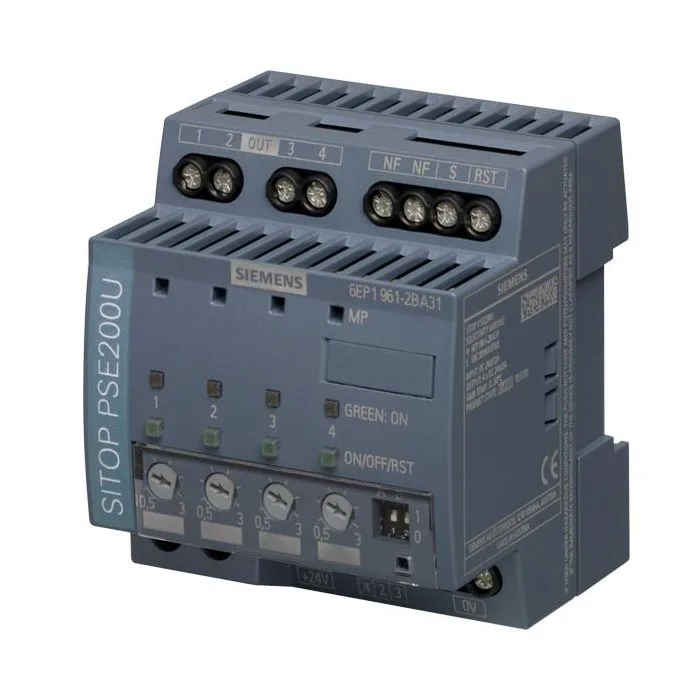
The Siemens 6EP1961-2BA31 is a SITOP buffer module that takes a 24 V DC input (22-30 V) and delivers four controlled DC outputs at Vin minus roughly 0.2 V. It snaps onto a DIN rail EN 60715 35x7.5/15, so it lands in the same panel as the SITOP power supply it buffers. The 72 mm width and 80 mm height keep it to a single DIN-space footprint — useful when you're packing a control cabinet and every millimeter of rail matters.
The 97% efficiency means the module doesn't waste much heat inside the enclosure — less derating worry when you stack it next to other DIN-rail gear. The output voltage tracks the input minus about 0.2 V, so if your supply is set to 24.5 V, the buffer delivers roughly 24.3 V at the outputs. That's tight regulation for a buffer stage; you're not losing a volt across the module. Overcurrent protection is staged: for a sustained overload of 1.0 to 1.5 times the set current, it switches off after about 5 seconds. For a hard short, the current limit kicks at 1.5 times set value and trips in typically 100 ms. That gives you selectivity headroom downstream — a branch fault clears before the buffer drops, so the rest of the 24 V bus stays up. The remote reset input is a non-isolated 24 V signal that accepts a "high" above 15 V. Wire it to a PLC digital output or a pushbutton, and you can reset the module after a fault without opening the panel door. Handy for remotely cycled machinery or locked cabinets.
Clearance and Mounting
The spec calls for 50 mm clearance above and below the module. That's for natural convection cooling — the module is rated for -25 to +60 °C operation with natural convection, so don't box it in tight. Left and right clearance can be zero, meaning you can butt-mount modules side by side on the DIN rail. That's the standard SITOP footprint: 72 mm wide, 80 mm tall, 72 mm deep.
The module carries CE marking, EAC approval, and UL recognition under UL 2367 (File E328600) plus cULus listing to UL 508 and CSA C22.2 No. 107.1 (File E197259). It also holds shipbuilding approvals from DNV GL and ABS. Safety is designed to EN 60950-1 and EN 50178. For EMC, emitted interference meets EN 55022 Class B and immunity meets EN 61000-6-2 — so it's suited for industrial environments without needing an external filter for conducted emissions.