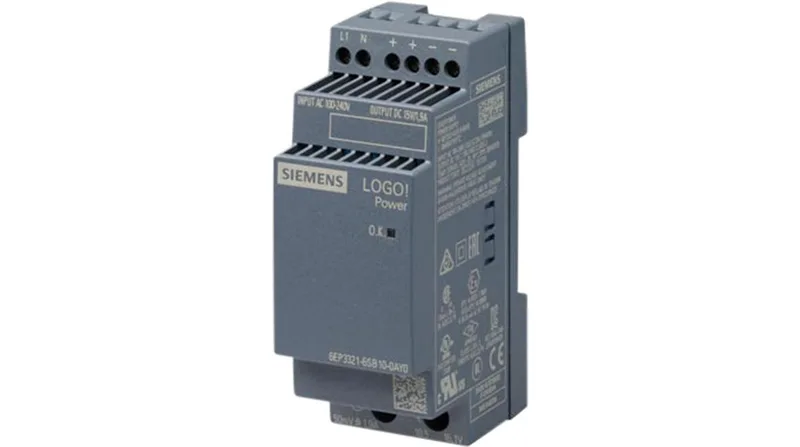
Current SITOP line, 2.5 A continuous at 24 V
The 6EP3321-6SB10-0AY0: At 1.9 A the device holds full output up to +55 °C with natural convection; from +55 °C to +70 °C the rating derates linearly at 2 % per kelvin, which is the figure the panel thermal budget has to respect when the cabinet sits above a heat source or in a sealed enclosure.
Wide-range input and feeder coordination
Input accepts 85 V to 264 V AC at 47 to 63 Hz, plus a DC window of 110 V to 300 V — that covers single-phase industrial mains worldwide and lets the same unit ride a DC back-up bus during a mains dropout without re-specification. The recommended upstream protection is a 6 A characteristic B or 2 A characteristic C miniature breaker, sized to ride the inrush I²t of 0.8 A²·s without nuisance tripping. Output SELV per EN 60950-1 and EN 50178 with internal fusing — the isolation barrier is what allows the 24 V rail to be run to operator-accessible terminals without additional protection.
Panel fit, clearances, and approvals
Mounting is a snap onto DIN rail EN 60715 35x7.5/15, with direct mounting supported in different orientations; the listed clearance envelope is 20 mm top, 20 mm bottom, 0 mm left and right, which is what dictates the side-by-side stacking pattern in the cabinet. The IP20 rating is finger-safe from the front but does not extend to the screw terminals, so a terminal cover is needed if the cabinet door opens into an operator zone. Approvals cover cULus-Listed under UL 508 and CSA C22.2 No. 107.1 (File E197259), cURus-Recognized under UL 60950 and CSA C22.2 No. 60950 (File E151273) with NEC class 2 per UL 1310, plus EAC and DNV GL marine — the marine register is what allows the same part number into a bridge or engine-room cabinet without a separate spec. ATEX and IECEx are not on the certificate, so hazardous-area cabinets still need an Ex-rated supply upstream.
Reliability and procurement posture
MTBF at 40 °C is 2,938,542 h — a figure that supports long-spare stocking for an MRO shelf without a refresh cycle.