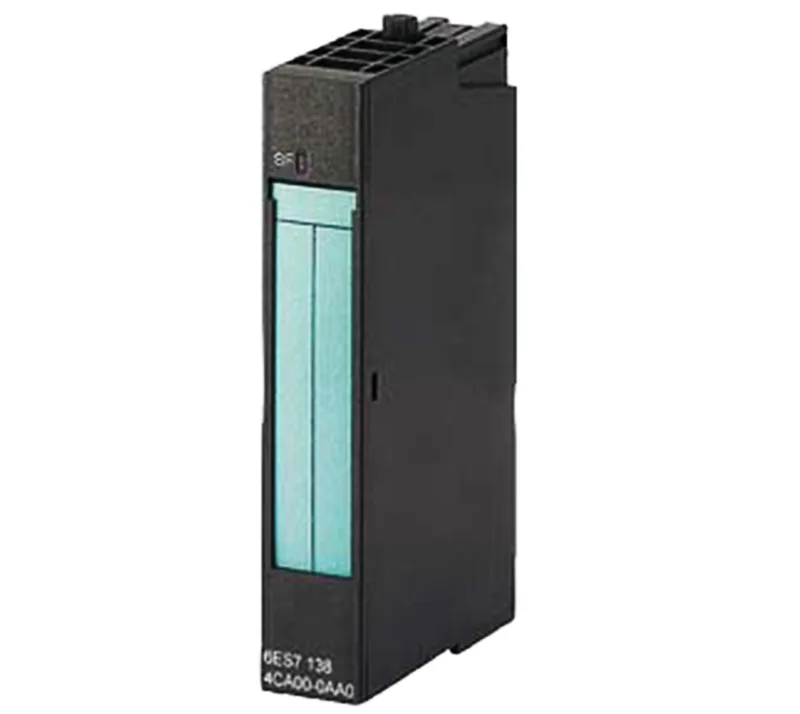
RTD input module for Pt100 and Ni100
The Siemens 6ES7134-4JB50-0AB0 is a 2-channel analog input module for the ET200S distributed I/O system, purpose-built for Pt100 and Ni100 resistance thermometers. It integrates directly into the ET200S terminal block and draws its 24 V DC supply from the power module, so no separate field supply is needed for the electronics. Each channel accepts Pt100 standard/climate and Ni100 standard/climate ranges, with selectable measurement ranges of 150 Ω, 300 Ω, or 600 Ω. The input resistance sits at 2 MΩ for both RTD types, which keeps self-heating errors negligible on standard 3- or 4-wire connections.
Conversion timing and filtering
Conversion time per channel is 110 ms (130 ms with the 50 Hz integration time active). The module uses an integrating measurement principle, and the integration time is selectable between 16.7 ms and 20 ms to reject 60 Hz or 50 Hz line noise. Cycle time for all active channels equals the number of active channels multiplied by the basic conversion time. Digital filtering is parameterizable in four stages — none, low (4× cycle time), medium (64×), and high (128×) — letting you trade noise rejection against update rate per channel. The 4-byte address space per module covers both channels plus status.
Diagnostics and wire-break detection
Wire-break detection is available and works only on constant-current excitation lines — it is enabled or disabled per channel via the configuration software. Group diagnostics (SF red LED) and overflow/underflow flags are also parameterizable. Channel-to-channel isolation is not provided, but the module is isolation-tested at 500 V DC between the electronics and the backplane. The module does not support isochronous mode, so it is not suited for time-synchronized motion or high-speed closed-loop applications that demand deterministic jitter below the cycle time.
Power loss is 0.6 W typical, which keeps the thermal contribution to the enclosure low even in a fully populated rack. Reverse polarity protection is built in on the backplane connection.