Integration time and noise rejection
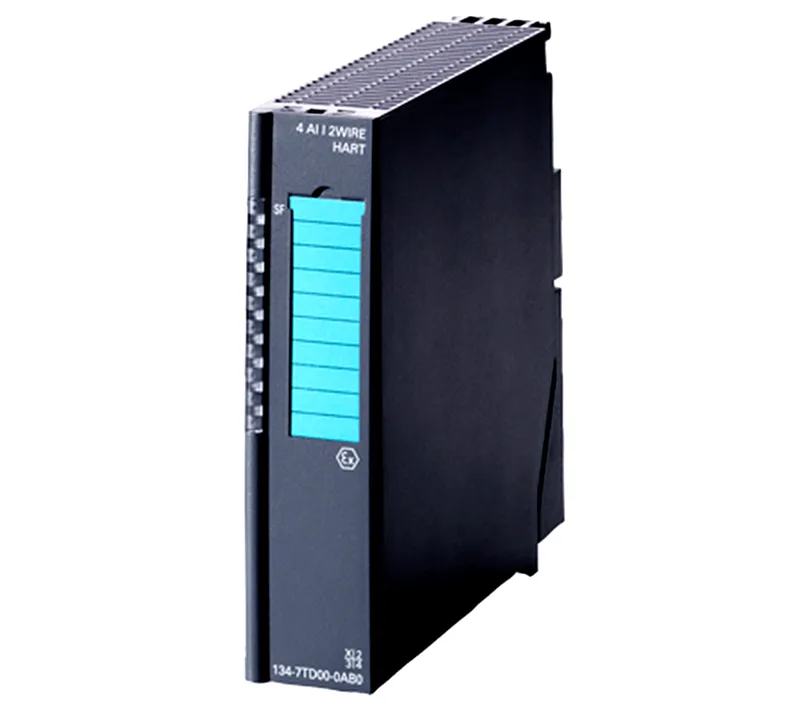
The 6ES7134-7TD00-0AB0: Integration is selectable in four parameterizable stages tied to line-frequency rejection. The fastest, "None", runs at 1× cycle time; "low" doubles to 4×; "medium" stretches to 32×; and "High" reaches 64×. With all four channels active the worst-case cycle time is 120 ms, derived from 30 ms basic conversion per channel plus a four-channel scan at either 50 Hz or 60 Hz interference-frequency suppression. Crosstalk between inputs is specified at -50 dB minimum, and there is no electrical isolation between channels — only between the channel group and the backplane bus. Integration time is not freely adjustable — only the four preset stages are available, which is what ties the speed-versus-rejection decision to a fixed menu. Wire-break detection and short-circuit monitoring are both supported, and the diagnostic alarm plus limit-value alarm are parameterizable per channel. Diagnostic information is readable from the host, with the group error (SF, red LED) flagging module-level faults.
Lifecycle and procurement posture
No official replacement order code is published; any migration would be a redesign onto a newer ET 200S analog input family. For new BOM lines or spares, request a quote against an RFQ to confirm factory-channel availability and lead time.
Quality and compliance documentation
CE marking is declared and the ATEX marking covers gas group IIC, dust, and mining group I. Buyers should expect the EU Declaration of Conformity, the ATEX Type Examination Certificate, and the SIMATIC technical documentation pack. Panel builders specifying into hazardous-area installs should pin the ATEX certificate reference into the panel cert bundle.