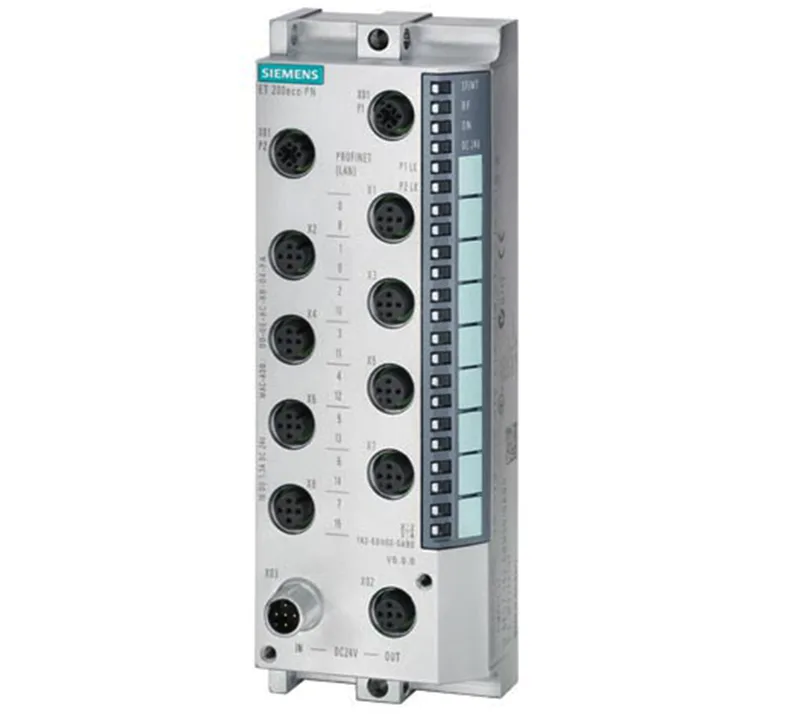
The Siemens 6ES7141-6BH00-0AB0 is a SIMATIC ET 200AL digital output block — a distributed I/O slice that sits in the field rather than in the cabinet, addressed as a PROFINET IO device and powered from a 24 V DC rail. It carries 8 outputs rated 24 V DC with a 100 mA per-output ceiling, switchable per channel from the PLC programme. The block has its own integrated 2-port switch and an M12 service interface, which is what lets it chain to the next ET 200AL station without a separate media converter. Sealing is IP65/67 at the housing, which is the point of putting an ET 200AL at the machine rather than running long homeruns back to a centralised rack.
What the I/O and timing figures mean for fit
100 mA per output is the per-channel ceiling, not a shared budget — so the rule of thumb is to count each solenoid, indicator or relay coil as one channel against the 100 mA line, not as a fraction of the module total. Output transition times are typically 3 ms both directions, which is fast enough for valve actuation and indicator work but not what you pick for high-speed counting; if the application is pulse output rather than coil drive, look elsewhere.
Network and diagnostics behaviour
On the network side the device supports ARP, DCP, MRP, LLDP, Ping and SNMP, which is the standard PROFINET IO service set and what allows the controller's diagnostic alarms to reach the HMI and engineering station. A group error LED labelled SF/MT in red/yellow gives a panel-side at-a-glance health check, and prioritised startup is supported so the block can join a fast-tool-change PROFINET segment without slowing the line. Transmission is 100BASE-TX at up to 100 Mbit/s, with autonegotiation and autocrossing handled by the integrated switch.
Power, isolation and cabinet-side maths
The 24 V DC circuits are type-tested at 707 V DC, and the typical power loss is 6.5 W — the figure to fold into the 24 V supply sizing for the field-distribution segment the block sits on.
Field-cable limits and the gotchas
Unshielded cable runs are rated up to 30 m, which is the field-length number to respect on a retrofit where pulling shielded cable back to a reworked station is impractical. There is no channel-to-channel isolation on the outputs, so any group with mixed loads — for instance a relay coil and a low-voltage indicator sharing the same block — needs external segregation rather than relying on internal barriers.