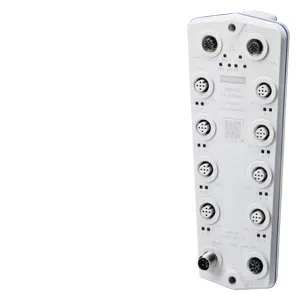
16 digital inputs in an IP69K-rated washdown enclosure
The Siemens 6ES7141-7BH00-0BB0 is a SIMATIC ET 200clean digital input module with 16 sink inputs at 24 V DC, distributed across eight M12 connectors — each M12 port carries two signals, halving the connector count and cable runs on the gland plate. The module implements IEC 61131-2 Type 3 input characteristics, and the input delay is configurable from 0.05 ms to 20 ms, so you can tune for high-speed cam sensors or debounce wet contacts that flicker under spray.
The defining feature is the IP69K rating: the module is sealed against high-pressure hot-water jets (80 °C at 100 bar) and rated for permanent immersion. On a poultry evisceration line, a dairy filling skid, or a CIP skid where everything gets foamed nightly, this module bolts directly to the machine frame — no auxiliary enclosure, no junction box with a gasket that eventually leaks. The ECOFAST hybrid connector carries both power and fieldbus, so daisy-chaining modules along the machine length is a single cable route.
Electrical and mounting profile
| Parameter | Value |
|---|---|
| Inputs | 16 DI, sink (PNP), 24 V DC |
| Connectors | 8 × M12, double-assigned |
| Input delay | 0.05–20 ms configurable |
| Input type | IEC 61131-2, Type 3 |
| Fieldbus | PROFINET (via ECOFAST hybrid) |
| Protection | IP69K |
| Ambient temperature | −25 °C to +55 °C |
| Dimensions (W×H×D) | 60 × 210 × 49 mm |
| Weight | Approx. 600 g |
Two things to check before ordering
ECOFAST hybrid connector: This module uses a combined power + data hybrid M12 connector system. If your existing ET 200pro or ET 200eco installation uses separate power and bus connectors, you will need the mating hybrid cable assembly — the module does not accept standard M12 A-coded power cords.
Sink vs. source: The 6ES7141-7BH00-0BB0 is a sinking input (PNP sensor compatible). If your field devices are NPN (sourcing), use the 6ES7141-7BG00-0BB0 instead — it is the sourcing-input variant with otherwise identical specifications.
Stock and sourcing
This is an active production part with position stock held in Shenzhen. We ship same-day for orders under 30 pieces. For project quantities above 100 modules, request a BOM line-item quote — we consolidate ET 200clean I/O, power modules, and cables on a single proforma for panel-shop delivery.