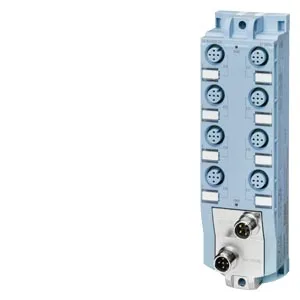
Rugged 8-output slice for distributed blocks
The Siemens 6ES7142-5AF00-0BL0 is an 8-channel digital output module for the SIMATIC ET 200AL family, built to live on the machine frame, not inside a climate-controlled cabinet. Rated IP65/67, it shrugs off washdown and airborne dust — the same housing that seals the electronics also carries the M12 L-coded power feed and the IO-Link port. Each output sinks 2 A at 45 °C, derated to 1 A at the 55 °C ceiling. That 2 A per channel at 45 °C is the number to size against — the module's 8 A total budget means you can load all eight channels near their 1 A limit at the top of the temperature range, or run a few channels at full 2 A and leave headroom on the rest. The -30 °C floor lets it sit unpowered in a frozen warehouse and wake up without condensation issues.
IO-Link 1.1 with a common profile means this module talks to any IO-Link master that supports the standard. The IODD file is available, so commissioning is drag-and-drop into the engineering tool. The 38.4 kBd COM2 transmission rate is the standard IO-Link speed — no surprises on cycle time. SIL 2 per IEC 62061 means the module can be used in safety-related control systems up to that integrity level. The per-channel electronic short-circuit protection trips at a typical 2.8 A threshold, and the module-level diagnostic alarm is parameterizable — you decide whether a fault stops the line or just logs an event. The 707 V DC type-test isolation between the load voltages and the logic side confirms galvanic separation. Channel-to-channel isolation is not provided, so all eight outputs share a common reference — plan your load grouping accordingly.
Mounting and wiring — checklist for the panel builder
The module measures 45 mm wide, 159 mm high, and 45 mm deep — it mounts directly on the machine frame or a sub-panel, not on a DIN rail. The M12 L-coded power connector carries 24 VDC to the module; the same connector family handles the eight output channels. The unshielded cable run can stretch to 30 m. The cycle time minimum is 2.1 ms — fast enough for most discrete applications but not for high-speed counting or pulse trains above 100 Hz on resistive loads. For inductive loads the switching frequency drops to 0.1 Hz (0.25 Hz at 25 °C); use a freewheeling diode or a varistor across the load to suppress the back-EMF.