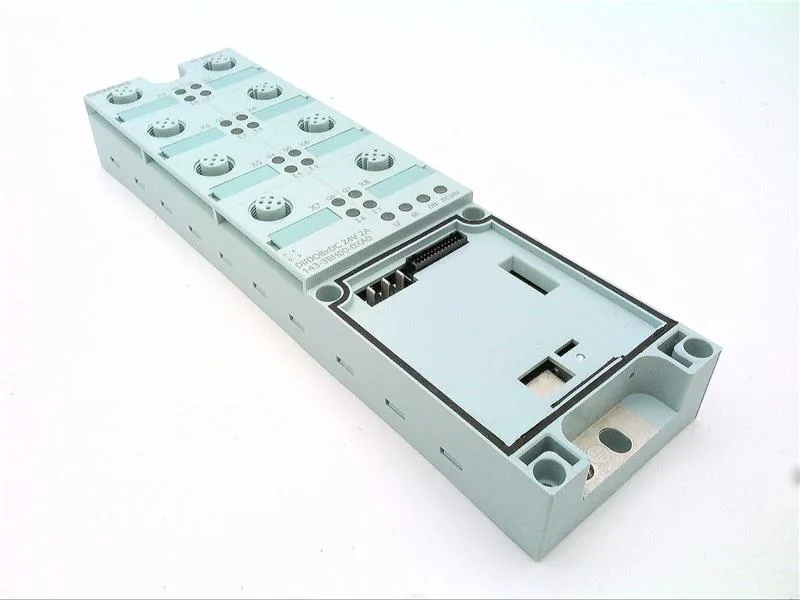
What it does on the bus
The 6ES7143-3BH00-0XA0 is a distributed field I/O module that drops onto a PROFIBUS DP network and exposes 8 digital inputs and 8 digital outputs back to the master PLC, rated for 24 V DC sensor and actuator wiring at the field end. PROFIBUS DP runs up to 12 Mbit/s on this module; the segment baud rate is set by the DP master, not by the station.
Channel-side ratings
Each digital output is rated 2 A on the '1' signal, with group-error indication via the red SF LED. Outputs are short-circuit protected but are NOT reverse-polarity protected — wire the field 24 V with the correct polarity. Switching speed is what governs the load mix: 100 Hz maximum on a resistive load, 1 Hz maximum on a lamp load, and 0.5 Hz maximum on an inductive load per IEC 60947-5-1, DC-13. Channel transition times are 3 ms typical in both directions, and the outputs are not isolated channel-to-channel.
Power and thermal
Station power is 24 V DC with 0.75 A rated value and a 0.75 A summation current up to 55 °C, so the upstream feeder and the power module both have to clear that budget across all eight outputs loaded together. Typical power loss is 5 W, which the IP65/67 housing has to dissipate without active airflow. Channel-level fault response is set at 4 A per channel, and per-socket current carrying is 4 A on each of sockets X1, X3, X5, X7 and 4 A on each of X2, X4, X6, X8 — the cable current-carrying capacity is the next bottleneck downstream of that.
Mechanical and field environment
The housing is 60 mm wide x 210 mm high x 28 mm deep, IP65/67 sealed, designed for cabinet-free mounting close to the sensors and actuators rather than back in the control panel. Unshielded cable runs are specified up to 30 m — beyond that, plan for shielded cable and verify EMC behavior in the field environment. Isolation is tested at 500 V DC, with 75 V DC / 60 V AC permitted between different circuits, which is the figure to check when the module sits adjacent to a higher-voltage field segment.
Diagnostics and parameterization
A red group-error SF LED is provided for module-level fault visibility; no channel-level alarms are reported back to the master from this variant. The module can also be used to control a digital input from the higher-level controller side, which is useful for handshake simulation during commissioning.