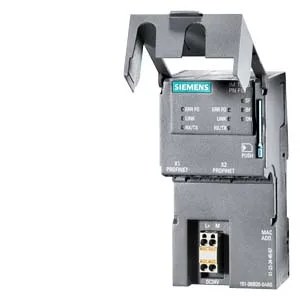
What the real-time and redundancy stack gives you
PROFINET capability is the full set a controls integrator plans around: ARP, IRT, MRP, and LLDP are all listed as supported, which lets the station act as an MRP client in a redundant ring and synchronize isochronous motion on IRT without an extra step on the controller side. Shared device is supported, with up to 2 IO controllers able to address the same station in parallel — useful for a PLC plus a safety CPU split, or for a process controller and a higher-level cell controller both needing visibility into the same I/O. PROFIenergy is listed, which is what lets the station drop into energy-aware tooling cycles without a custom profile on the controller. Prioritized startup is supported, which is the feature that gets a robot cell back online in the right order after a tool change or a brief line stop.
24 V budget and ride-through
Stored energy time on a mains or voltage failure is 20 ms, which is the bridge a brief brownout has to clear before the station drops — enough to ride a typical contactor coil pull-in dip on the same bus. Galvanic isolation is listed between Ethernet and electronics, so the fiber-side ground reference does not ride the backplane ground back to the controller cabinet.
Fault surface the night-shift tech will actually read
Diagnostics are exposed via the standard PROFINET alarm channel, and the module also responds to SNMP, so a plant that runs an SNMP poller can pull the station health without standing up a full TIA portal session. Autonegotiation and autocrossing are both on, which removes the manual crossover / speed fix on the copper side when the IM is used in a mixed-media segment; here both ports are fiber, but the feature set is consistent across the PN-FO family and is what a replacement IM is expected to honor.
Mechanical envelope and ambient class
The module is 119.5 mm tall by 60 mm wide by 75 mm deep (depth measured to the mounting rail), which is the standard ET 200S head-end footprint — it lands on the same DIN rail and uses the same termination module as the rest of the family. Operating temperature is 0 °C to 60 °C, so it covers the standard cabinet envelope without a cold-climate derate.
Compliance marks on the listing
The listing carries a CE mark and a UL approval, which is the documentation set a parallel-import or cross-border buyer normally asks for before the PO is released.
Spec recap and sourcing posture
Inputs and outputs on the station side are listed as 256 bytes each, which is the per-direction process image budget the controller-side configuration has to fit inside. Optical interface support is explicit, and the integrated 2-port switch means the ring closes on the module itself rather than needing an external media converter.