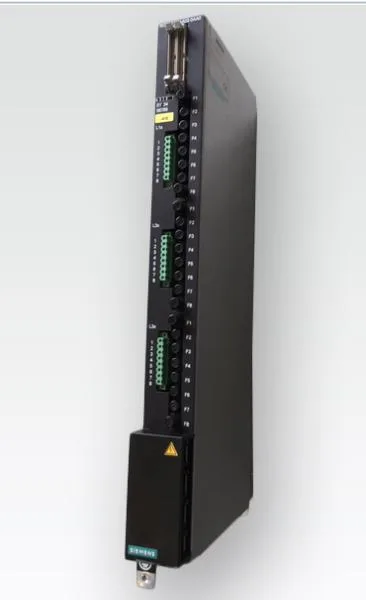
Encoder interface that holds the position loop
The Siemens 6ES7178-4BH00-0AE0 IM178 module is the dedicated encoder interface for the ET 200M distributed I/O system, designed to bring absolute and incremental position feedback into the PROFIBUS DP network without burdening the CPU with high-speed pulse counting. It accepts both SSI absolute encoders and incremental encoders with symmetrical A/B/N tracks plus zero-mark signals, and the clock frequency is parameterizable at 125, 250, 500, or 1 000 kHz — meaning the same module covers everything from a slow rotary table to a high-speed spindle axis, provided the cable run is sized accordingly.
Six inputs, six outputs, two analog — the I/O mix matters
Onboard are 6 digital inputs and 6 digital outputs, each rated for 24 V DC with the outputs sourcing up to 600 mA total and handling resistive loads at 500 Hz or inductive loads at 0.5 Hz — the inductive limit is the one that governs solenoid or contactor drive; the resistive figure is for indicator lamps or solid-state loads. Two analog outputs deliver a ±10 V signal, which is the standard interface for analog servo drives or proportional valves in a motion profile. The digital inputs accept 5 V differential signals (RS-422 physical layer) for the encoder tracks, with a logic "1" threshold of +11 to +30 V and a "0" threshold of -3 to +5 V — the wide hysteresis prevents chatter on long cable runs where common-mode shift is a risk.
Cable length derates with clock speed
The maximum shielded cable length is 320 m at 125 kHz, dropping to 160 m at 250 kHz, 60 m at 500 kHz, and 20 m at 1 MHz — a straight trade-off between update rate and physical distance that must be factored into the cabinet layout and field device placement. The input frequency and clock frequency both max out at 1 MHz, so the module can track a 1 MHz encoder signal without aliasing, provided the cable length is within the 20 m limit at that speed.
DIN-rail footprint and environmental range
The module measures 80 mm wide, 125 mm high, and 118 mm deep, fitting a standard DIN-rail slot in the ET 200M rack with the backplane connector engaging the active bus module.