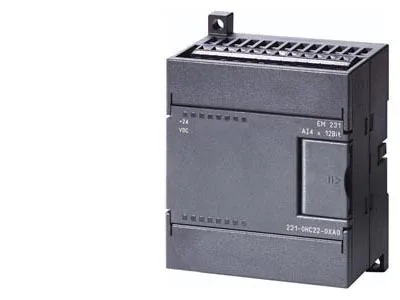
Signal types and channel assignment
The 6ES7231-0HF22-0XA0 is a 4-channel analog input module for the S7-200 family. Channels 0–5 accept voltage signals (0 to +5 V, 0 to +10 V, -5 V to +5 V, -2.5 V to +2.5 V). Channels 6 and 7 are the only ones that accept current inputs: 0 to 20 mA, and they also handle voltage. This split-channel architecture means you cannot mix current inputs across all four channels — if your loop-powered transmitters are on channels 0–5, you need a different module or external burden resistors. The module does not support thermocouple, RTD (Pt100, Pt1000, Ni100, etc.), or resistance inputs — those require the dedicated EM 231 RTD or thermocouple variants. For a 4–20 mA transmitter on channel 0, this module will not work; the current capability is limited to channels 6 and 7 only.
Resolution and wiring reach
Unipolar signals are converted to a range of 0 to 32,000; bipolar signals span -32,000 to +32,000. That gives roughly 15-bit resolution on the unipolar side and 16-bit including sign on bipolar — adequate for most process signals but not high-accuracy instrumentation. The shielded cable run to the sensor is limited to 100 m maximum, which is typical for this generation of S7-200 analog modules and fine for in-panel or local field wiring. Power dissipation is 2 W typical — negligible for the S7-200 backplane budget, but worth noting if the enclosure is sealed and densely populated. Dimensions are 71.2 mm wide, 80 mm high, 62 mm deep; it mounts directly on the DIN rail alongside the CPU and other expansion modules.
No stock-holding claim; this is a per-order procurement path.