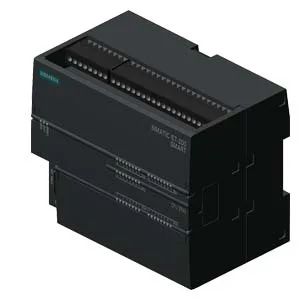
The Siemens 6ES7288-1SR40-0AA0 is an S7-1200 CPU with 24 kbyte of program memory (DDR RAM backed by Flash), enough for medium-size machine logic — think a packaging cell or a small conveyor line with a few dozen rungs and a PID loop or two. It supports LAD, FBD, and STL programming, so your existing codebase in any of those languages ports straight in. The CPU handles up to 144 bytes each of digital and analog I/O (256 bits digital, 56 words analog), with a per-device cap of 128 bytes for inputs and outputs — that covers a local rack plus a couple of remote slices over PROFINET. The 1500 V AC transformer isolation on the supply (120/230 V AC) means you can run it on a dirty line without worrying about conducted noise crashing the logic — common in retrofit panels where the isolation transformer was skipped. Built-in PID controller handles up to 8 loops with continuous or binary outputs and auto/manual mode — no separate loop controller needed for temperature, pressure, or flow regulation. The real-time clock is maintenance-free but needs 7 days of power-on to charge the supercap; after that it holds time for about 7 days without power. If your process logs events with timestamps, plan for a brief RTC recharge after a long shutdown.
Fieldbus and networking — what fits where
PROFINET is onboard with autonegotiation and autocrossing (auto MDI/MDI-X), so you can plug into any switch or direct to a PC without a crossover cable. The minimum update time is 4 ms, but that depends on the IO device count and data volume — expect around 4–8 ms for a small network. For legacy fieldbus, an RS-485 port runs at up to 187.5 kbps (the standard PROFIBUS baud), and the CPU can act as a PROFIBUS client or server via a CM DP module — useful when you're tying into an older drive or remote I/O island. The RS-485 interface is electrically isolated? The evidence doesn't say, so treat it as non-isolated and add an isolator if the cable runs outside the panel or shares a tray with VFD leads. Shielded cable max is 500 m; keep it under that to avoid signal degradation.
High-speed counters and forcing — edge cases covered
Six high-speed counters are parameterizable: four single-phase at 200 kHz and two at 30 kHz, or four A/B-phase quadrature at 100 kHz and two at 20 kHz. That covers encoder feedback for a servo axis or a fast count from a proximity sensor on a bottling line. Forcing is supported — you can override inputs or outputs during commissioning without changing the program, which saves time when you're chasing a wiring fault.