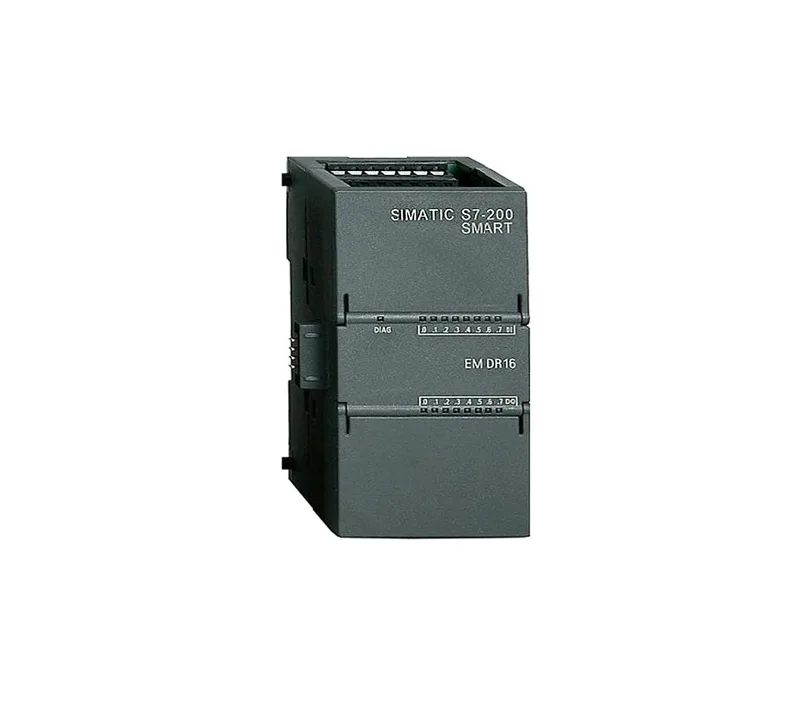
The Siemens 6ES7288-2DR16-0AA0 is a digital I/O module for the S7-200 SMART PLC family, packing 8 digital inputs and 8 relay outputs into a 45 mm wide housing that snaps onto a DIN rail inside a control panel. It's the kind of block you spec when you need a mix of discrete sensing and switching on a single slice — no separate input and output cards, just one part number to order and one slot to fill on the backplane. The 8 digital inputs are 24 VDC sink/source, with a signal-1 threshold of +15 to +30 V and a typical draw of 4 mA per channel. That means it will read standard 24 VDC proximity sensors, limit switches, or pushbuttons without any level-shifting — common in cement plant control rooms where 24 VDC is the standard for panel-side signals. The 8 relay outputs are rated 2 A per channel on both resistive and inductive loads, and up to 30 W on DC lamp loads (200 W on AC). That 2 A per channel is the real-world limit — don't plan on paralleling outputs to drive a bigger load unless the wiring rules allow it, because the module has no short-circuit protection on the output side. Each relay is a dry-contact type, isolated between channels, so you can switch different voltage levels on different outputs without cross-talk.
The 45 mm width and 81 mm depth are the dimensions that matter for panel layout — it takes up about the same DIN-rail footprint as a standard miniature circuit breaker. The 100 mm height is standard for S7-200 SMART modules, so it aligns vertically with adjacent CPU or signal boards. The input response times are fast enough for most discrete control: 200 µs on-to-off and off-to-on. That catches a proximity sensor passing a part at line speed without missing a count. The relay outputs are slower — 10 ms max for both directions — which is typical for electromechanical relays and fine for solenoids, contactor coils, or indicator lamps, but not for high-speed pulse trains or PWM. Unshielded cable runs up to 150 m and shielded up to 500 m are the listed maximums for the inputs. In a cement plant where sensors might be scattered across a long conveyor line, that 150 m unshielded reach is useful — just keep the cable away from VFD output cables and welding supplies to avoid noise pickup.
The module draws 80 mA from the 24 VDC backplane supply. That's modest — a typical S7-200 SMART CPU can power several of these before hitting the internal bus current limit. Reverse polarity protection is built in on the input side, so a wiring mistake won't fry the module, but the relay outputs are dry contacts — no internal suppression, so add a flyback diode across any inductive DC load (solenoid valve, contactor coil) to protect the relay contacts from arcing. Inputs can be wired in groups of 2 (common per pair), and parallel switching of inputs is allowed — handy if you need to wire a single sensor to two input points for redundancy or monitoring. The isolation test is 500 V AC for 1 minute on the input side and 1500 V AC for 1 minute on the output side, so there's solid galvanic separation between the low-voltage control logic and the field wiring.