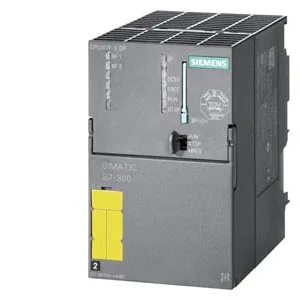
Safety CPU with FM 8 — what that means for your safety loop
The 6ES7315-2FH13-0AB0 is a Siemens S7-300 fail-safe CPU (type SFB) with 8 kB of fail-safe memory (FM 8). That FM 8 figure is the dedicated safety program capacity — separate from the standard user memory — and it governs how many safety functions (emergency stops, light curtains, two-hand controls) you can run in a single CPU. With 2048 bytes maximum for the safety program itself, this CPU is sized for medium-complexity safety applications on a single machine or small production cell. It supports PROFIsafe for safety communication over PROFINET, meaning the safety signals travel on the same cable as standard I/O, with a black-channel approach that keeps the safety layer independent. The CPU can act as both a PROFIsafe client and server, so it fits into distributed safety architectures where one CPU coordinates multiple remote F-devices.
Programming environment and toolchain constraints
This CPU is programmed in STEP 7 V5.3 SP3 or higher (with the appropriate hardware update). That is a hard gate — if your engineering station runs TIA Portal exclusively, this CPU requires the classic STEP 7 environment. It supports LAD, FBD, STL, SCL, GRAPH, HiGraph, and CFC, so the safety logic can be authored in any of the standard IEC 61131-3 languages plus the Siemens-specific CFC for continuous function chart programming. The CPU has 244 bytes each of process input and output image, and supports forcing of variables for commissioning. Retentive data must be explicitly restarted at each restart — not automatic — so plan your warm-start behavior accordingly.
The module is 80 mm wide, 125 mm high, and 130 mm deep — a standard S7-300 single-width form factor that snaps onto the DIN rail and connects via the backplane bus. The integrated PROFINET interface is on the front, with an RJ-45 port for the network connection. No MPI port on this CPU (MPI: No), so all programming and HMI communication goes through PROFINET or via a CP module. It supports up to 4 CPs for additional PROFIBUS or industrial Ethernet connections, 10 CPs for LAN, and 8 CPs for PtP (serial) communication. The RS 485 interface is present for point-to-point or simple network connections.
The closest functional peer in the S7-300 safety family is the 6ES7315-2EH14-0AB0, which offers a later hardware revision and expanded memory. The 2FH13-0AB0 drops into the same DIN-rail slot and backplane, but the 2EH14-0AB0 requires a newer STEP 7 version and may have different firmware behavior. Verify the specific safety program size and toolchain before substituting.