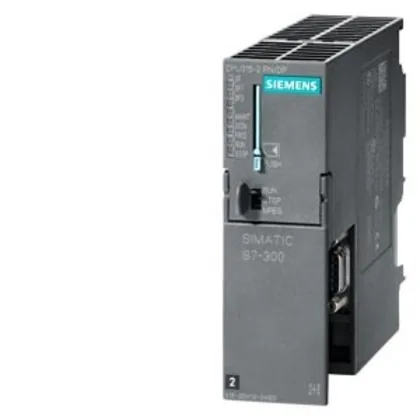
CPU 315-2 PN/DP — 244-byte process image, PROFINET IRT
The Siemens 6ES7315-2EH14-0AB0 is a CPU 315-2 PN/DP for the SIMATIC S7-300 family, with 244 bytes each of process input and output image — enough to handle a medium-sized distributed I/O rack without expanding the address space. It supports PROFINET IRT (isochronous real-time) via the integrated PN interface, plus TCP/IP and UDP through loadable function blocks — the IRT capability means deterministic cycle times down to 1 ms for motion or high-speed logic. The CPU is not PROFIsafe-rated (no safety SIL/PL certification), so it belongs in standard control tasks, not safety circuits — separate a fail-safe CPU for any guarding or emergency-stop logic.
Programming languages and engineering toolchain
Programmable in LAD, FBD, STL, SCL, GRAPH, HiGraph, and CFC — the CFC (Continuous Function Chart) support is useful for signal-flow-oriented logic without writing line-by-line code, common in process or batch applications. Requires STEP 7 V5.5 or higher — confirm the engineering station version before starting a project; older TIA Portal versions may not load this CPU's hardware configuration. FM 8 function blocks are available on-board, covering standard math, comparison, and conversion operations without additional library licensing.
Communication interfaces and module expansion
Integrated PROFINET interface supports both IO controller and IO server roles, plus routing — useful for segmenting a plant network without extra switches. An RS 485 interface is present for point-to-point or multi-drop serial connections (e.g., Modbus RTU via loadable FCs). The rack can hold up to 4 communication processors (CPs), 10 LAN connections via CP, and 8 PtP connections — enough for a multi-protocol gateway setup. No DPV1 support — if the application requires PROFIBUS DP-V1 (acyclic data exchange for parameterization), this CPU cannot serve as a DP master; use a separate CP 342-5 or upgrade to a CPU with DP-V1.
Memory, retentivity, and forcing
Retentive memory is present but must be restarted at each restart — meaning the retentive data area is cleared on a power cycle unless explicitly configured in the hardware config. Forcing is supported — useful during commissioning to override I/O states without modifying the program, but note that forced values survive a CPU stop/run transition. The retentive variables cover inputs, outputs, memory bits, data blocks, timers, and counters — the default preset is 10, adjustable in STEP 7.
Mechanical fit and environmental limits
Dimensions are 40 mm wide, 125 mm high, 130 mm deep — standard S7-300 single-width module, snaps onto a DIN rail in the same footprint as other 315-series CPUs. Rated for 0 °C to 60 °C ambient — suitable for ventilated enclosures; derate if mounted above heat-generating drives or power supplies. Electrically isolated between the backplane bus and I/O — no ground-loop issues when mixing field power supplies.