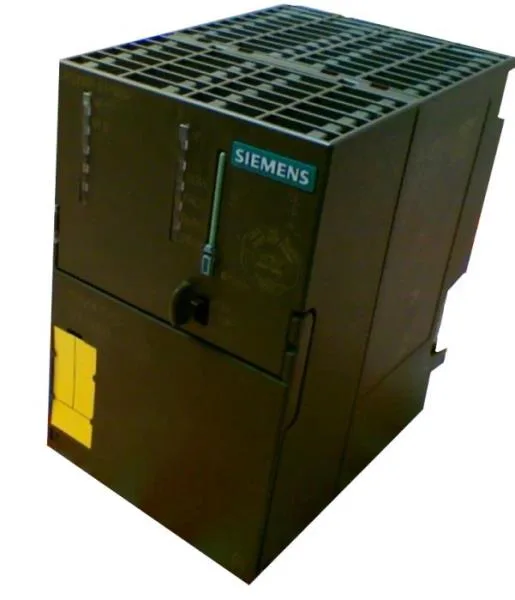
The Siemens 6ES7315-2FH10-0AB0 is a failsafe CPU in the S7-300 family, built for safety-oriented automation up to SIL 3 / PL e. FM 8 means it runs up to 8 safety function blocks (SFBs) simultaneously — enough to cover an emergency-stop chain, two light-curtain zones, a muting sequence, and a safe speed monitor on a single processor without overloading the cycle budget. It carries 244 bytes each for inputs and outputs, with a 16 kbyte work memory limit, so the safety program plus standard logic must fit inside that footprint. The 125 mm height and 80 mm width are standard S7-300 single-width — it occupies one slot in the DIN-rail-mounted rack, leaving room for I/O and CP modules alongside. Programming requires STEP 7 with HSP 88 (or SP3 without the HSP) and supports LAD, FBD, STL, SCL, GRAPH, CFC, and HiGraph® — so the same CPU handles safety logic in FBD or LAD and the standard control in STL or SCL without a separate toolchain.
I/O mapping and memory — 244 byte ceiling
The 244-byte input and output limit is the process-image size; distributed I/O via PROFINET or PROFIBUS is mapped into this window. Forcing is supported, which lets a commissioning engineer override outputs during FAT without rewiring — the forced values survive a memory reset only if retentivity is configured. The backup time is 6 weeks at 40 °C ambient — the internal capacitor holds the retentive data for that window after power loss. No retentivity is preset; the user must configure which DBs, timers, and counters survive a restart.
PROFINET and RS 485 — dual-port connectivity
The integrated PROFINET interface supports TCP/IP via loadable FBs, routing, and operation as both client and server. RS 485 is also on board for point-to-point or multi-drop connections to drives or barcode scanners. For additional networks, the CPU can handle up to 4 CPs for LAN, 10 CPs for LAN, and 8 CPs for PtP — so it scales to multi-protocol setups (PROFIBUS, Ethernet/IP, Modbus TCP) via communication processors in adjacent rack slots.