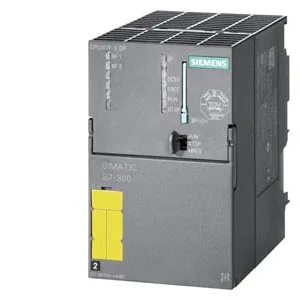
The Siemens 6ES7317-6FF03-0AB0 is a SIMATIC S7-300 CPU 317F-2 PN/DP — a fail-safe safety controller (type SFB) that runs standard and safety-oriented programs on the same hardware, with PROFIsafe communication over the integrated PROFINET interface. It carries 244 byte each of process-input and process-output image, so it handles a medium-sized safety application without an external I/O expansion rack, though the local I/O count is limited to the backplane slots. The FM 8 figure is the number of function blocks the CPU can execute in its firmware — eight, which is the standard count for this generation; it means the runtime environment has that many slots for pre-configured safety or standard logic blocks, not that you are limited to eight blocks in your program.
Programming and engineering constraints
This CPU supports LAD, FBD, STL, SCL, GRAPH, HiGraph, and CFC programming languages, and requires STEP 7 V5.2 SP1 or higher. CFC (Continuous Function Chart) support is notable — it allows data-flow-oriented programming, which is useful for safety logic that must be traceable and auditable. The engineering station must be at that version or later; older STEP 7 installations will not recognize this CPU.
PROFIsafe and safety routing
PROFIsafe is supported, meaning the CPU can exchange safety-related data with distributed F-devices over PROFINET without a separate safety bus. Routing is possible with the interface active, so a PG/PC can reach the safety program through the same PN port. The CPU acts as both PROFINET IO controller and as a PROFIsafe F-host. It can also serve as a DP slave via CP, and as a PROFIBUS client or server through a CP and loadable blocks.
Physical integration and mounting
The module measures 80 mm wide, 125 mm high, and 130 mm deep — it occupies two standard S7-300 slot widths on the DIN rail. The depth is the same as other S7-300 CPUs, so it fits existing enclosures without a deeper gland plate. No expandability for additional local I/O beyond the backplane slots. The integrated PROFINET ports are two, enough for a line topology without an external switch in many small cells.