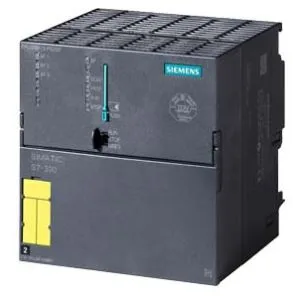
The Siemens 6ES7318-3FL00-0AB0 is a SIMATIC S7-300 Safety Fault-Protected (SFB) CPU, built for safety-oriented automation tasks where standard CPUs cannot be used. It carries FM 8 (failure memory 8 entries) and supports CFC (Continuous Function Chart) alongside FBD, LAD, SCL, STL, GRAPH, and HiGraph programming languages — covering virtually every IEC 61131-3 method and Siemens-specific safety engineering tools. The integrated PROFINET interface handles UDP and TCP/IP communication, with loadable function blocks enabling client/server roles. I/O addressing reaches 244 bytes each for inputs and outputs, and the rack accommodates up to 32 modules. Dimensions are 120 mm width, 125 mm height, and 130 mm depth.
Programming and Engineering
This CPU is programmed exclusively via STEP 7 V5.4 SP4 or higher with the appropriate hardware update package — no TIA Portal compatibility is stated in the evidence. The supported language set includes LAD, FBD, STL, SCL, GRAPH, HiGraph, and CFC, which means any existing S7-300 safety application written in these dialects can be directly ported. The I2t value of 1.2 A²·s is the thermal energy limit for the module's internal protection — relevant when sizing the power supply and backplane current draw.
Communication and Networking
PROFINET is onboard with UDP and TCP/IP support; loadable function blocks enable both client and server operation without an external communications processor. For legacy fieldbuses, RS 485 is present but MPI is not — so a direct MPI connection to an older S7-300 or S7-400 is not possible without a CP. The CPU supports routing, meaning PROFINET and PROFIBUS segments can exchange data through it. For PROFIBUS DP, it does not support DPV1 natively, but DP communication is possible via a CP module (up to 4 CPs for PROFIBUS, 10 CPs for LAN, 8 CPs for PtP). The GSD file for PROFIBUS integration is available from Siemens' website.
Memory and Data Handling
Retentive data is supported but must be explicitly restarted at each CPU restart — this is not automatic on power cycle. The retentive zone includes inputs, outputs, memory bits, data blocks, timers, and counters. Forcing is available for troubleshooting. The diagnostic buffer is preset to 10 entries and can be adjusted from 10 to 499 entries. The failure memory (FM) stores 8 entries — this is the number of safety-related fault events retained for analysis. The overall number of modules on the rack is limited to 32.