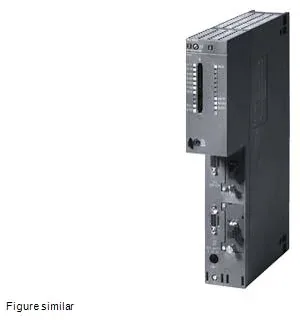
What this CPU is and what it handles
The Siemens 6ES7417-4HT14-0AB0 is a fault-tolerant CPU for the S7-400H system, designed for redundant, high-availability control in critical processes. It supports 8,192 inputs and 8,192 outputs, giving it the I/O footprint for a large distributed line or a safety-instrumented skid. Programming options cover CFC, FBD, LAD, SCL, STL, GRAPH, and HiGraph, so whichever language your team standardised on — structured text for complex math, ladder for discrete logic, or CFC for signal-flow — this CPU runs it natively. The FM (function module) capacity is limited by the number of slots and connections in the rack — the exact limit depends on the backplane configuration, not a fixed count. For a specific build, the S7-400H fault-tolerant systems manual gives the slot-by-slot rules.
Dimensions are 50 mm wide, 290 mm tall, and 219 mm deep — a standard S7-400 form factor that mounts on the rack without extra adapters. The CPU sits in a UR2 or CR2 rack alongside the redundant partner CPU. Slot assignment follows the H-system rules — the two CPUs occupy specific slots, and the sync modules link them across the backplane.
Communications and remote I/O
Built-in MPI (max. 200 ms cycle time) and RS 485 ports handle local programming and HMI connections. For distributed I/O, the CPU supports up to 10 connections via CP (PtP) modules, with the same slot-and-connection limits as the FM capacity. Routing is enabled, so the CPU can forward PG/PC communications across subnets without a separate router. It operates as both a Modbus client and server over the integrated ports.