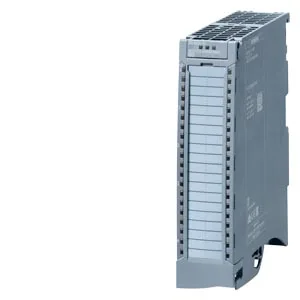
The Siemens 6ES7532-5ND00-0AB0 is a SIMATIC S7-1500 analog output module that drops onto the S7-1500 backplane next to the CPU, occupying a 35 mm slice of DIN real estate at 147 mm tall and 129 mm deep, and it draws 5 W typical from the 24 V DC supply while sitting on the same L+ rail the rest of the station uses. This is the output side of an S7-1500 analog station: the CPU writes a real to the channel, the module drives the corresponding voltage or current out to the field device, and it reports back per-channel and module diagnostics so the controls integrator can see a failed loop without walking the panel. Lifecycle is current production per the spec table, so the part is specified-into-the-BOM rather than chased as last-time-buy. Quote against an RFQ for the supply posture.
Output spans and field-side behaviour
Wire-break detection runs only on the current output type, and short-circuit detection only on the voltage output type — wire the loop to the current setting if you need open-loop visibility, and to the voltage setting if you need a hard short flag on a 0–10 V drive. Settling times land at 0.2 ms on a resistive load, 2 ms on an inductive load, and 1.8 ms on a capacitive load, so a fast proportional valve or a soft-driven actuator both stay inside one settling envelope without reconfiguration. Maximum shielded cable run is 800 m on a current output and 200 m on a voltage output, which is the binding layout number when the junction box sits well away from the cabinet — pull voltage loops short, push current loops where you need distance.
Diagnostics, isochronous, and safety footprint
The module supports isochronous mode and prioritized startup, and carries I&M data from I&M0 to I&M3, so it can be named, identified, and read-back during commissioning without an extra parameter file floating on a laptop. Front-panel indicators give a green RUN LED, a red ERROR LED for module diagnostics, a green channel-status LED per channel, and a red channel-diagnostics LED per channel, which is what the field-service tech reads first when a loop goes flat. Wire-break on the current path and overflow/underflow on the value path are both flagged back to the CPU, which shortens the time between a failed transmitter and a yellow bar in the HMI.
Configuration, firmware, and accuracy envelope
Firmware is V1.1.0 on this build, HW functional status is from FS01, and the firmware is update-capable in the field, so a future revision lands as a routine download rather than a card swap. Below 0 °C the operating error and temperature error figures double, which is the binding clause for any cold-room or outdoor-enclosure deployment — the card still runs, the accuracy envelope just widens on the way down.